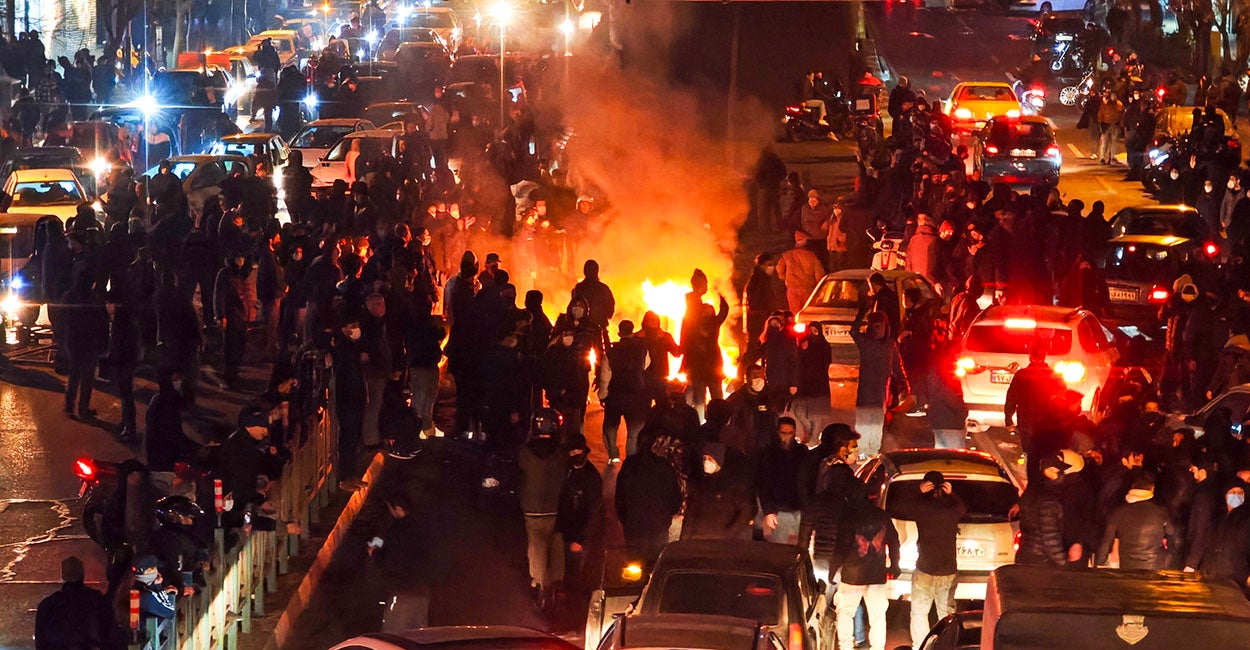
As Iranians take to the streets amid persistent inflation and a regime crackdown, President Donald Trump told protesters that “help is on its way“—but he has already given the poor people oppressed by Supreme Leader Ayatollah Ali Khamenei critical aid by enabling the conditions for their revolt.
Protesters took to the streets amid extremely high inflation on Dec. 28, and by this past Saturday, the rallies had grown to 574 locations in 185 cities across all 31 provinces, according to CNN. The regime has responded with its customary ruthlessness, shutting down the internet and killing an estimated 12,000 protesters.
The regime has successfully quelled protests in previous years, from the 2009 Green Movement (sparked by a disputed presidential election) to the 2019-2020 protests (also triggered by economic conditions) to the 2022-2023 protests after Mahsa Amini died in morality police custody after she refused to wear a hijab.
What’s different this time? The economic conditions are even worse, and the regime has lost its moral and military credibility.
Iran’s currency—the rial—lost nearly all its value. Last week, one U.S. dollar traded for 1.47 million rials. The economic crisis comes after President Trump re-imposed maximum pressure on Iran last February, after he announced an all-of-the-above energy strategy that does not move away from oil, and after a series of devastating military defeats for the Mullahs.
Iran’s theocratic regime rests its legitimacy on its ability to fight the “little Satan,” Israel, and the “great Satan,” the United States of America. The Islamic Republic came to power after the revolution ousted the U.S.-backed shah, Mohammad Reza Pahlavi. Iran has declared its intention to wipe Israel off the map. Its harsh enforcement of the Shia version of Sharia law is only possible because the regime unites its people against common enemies.
Trump’s Role
Former President Barack Obama thought the regime would soften if he offered compromise, and he hoped to create regional stability in the Middle East by pitting a stronger, more moderate Iran against Saudi Arabia. President Trump rightly threw out this flaccid approach, using maximum pressure sanctions in his first term and showing an even more aggressive support for Israel in his second.
Former President Joe Biden loosened the sanctions on Iran, leading the regime to gain approximately $71.02 billion more than it otherwise would have ahead of the Oct. 7, 2023, attack on Israel.
This extra cash likely enabled Iran to provide more support to its proxies in the region, including Hamas in Gaza, Hezbollah in Lebanon, the Houthi rebels in Yemen, and Iran-backed militias in Iraq. Iran uses these proxies, and the Islamic Revolutionary Guard Corps, to project power against Israel and America outside its borders.
Yet Oct. 7 set in motion a chain of events that crippled Iran’s power in the Middle East.
Israel responded with force, dismantling Hamas. In September 2024, Israel effectively eviscerated Hezbollah by rigging the terrorist group’s pagers to explode.
President Biden pledged to support Israel, but his support proved tepid at best. By contrast, Trump stood by America’s ally, providing the cover Israel needed to carry out its mission. Trump also bombed the Houthis in Yemen last year after the Iranian proxy repeatedly attacked international shipping.
Last June, Israel directly attacked Iranian nuclear sites, and U.S. forces under Trump provided crucial assistance in destroying the key nuclear sites of Natanz, Isfahan, and Fordow.
Rather than engage in regime change or a protracted war, President Trump urged Iran to make peace, ending the Twelve Day War with a massive victory for America and Israel.
In a masterstroke, Israel and the U.S. had dismantled Iran’s proxies and the rogue regime’s nuclear program—the Mullahs’ greatest hope for a decisive victory against Israel.
Yes, the Protests Really Are Different This Time
Iran’s crippled role in the Middle East doesn’t just make Israel and America’s allies in the region safer—it also undermines the Islamic Republic’s reason for existence. Whatever Iran’s troops believe, the clerical authorities aim to spread their version of Islam across the globe, and if they can’t fight the two regimes they consider the most evil—America and Israel—they lose their key justification for rule.
The protests may not succeed, and even if they do, it is possible the resulting regime will not represent much of an improvement.
However, Trump and Israel have done the people of Iran a great service by eviscerating the Mullahs’ military might, and it just might be enough to end the Islamic Republic’s despotic rule, once and for all. Even if it survives, the crippled regime will remain a pale shadow of its former self.
As an admirer of ancient Persia, I can’t help but hope that Iran’s best days are ahead—and if they are, the Persian people will have Trump to thank for it.