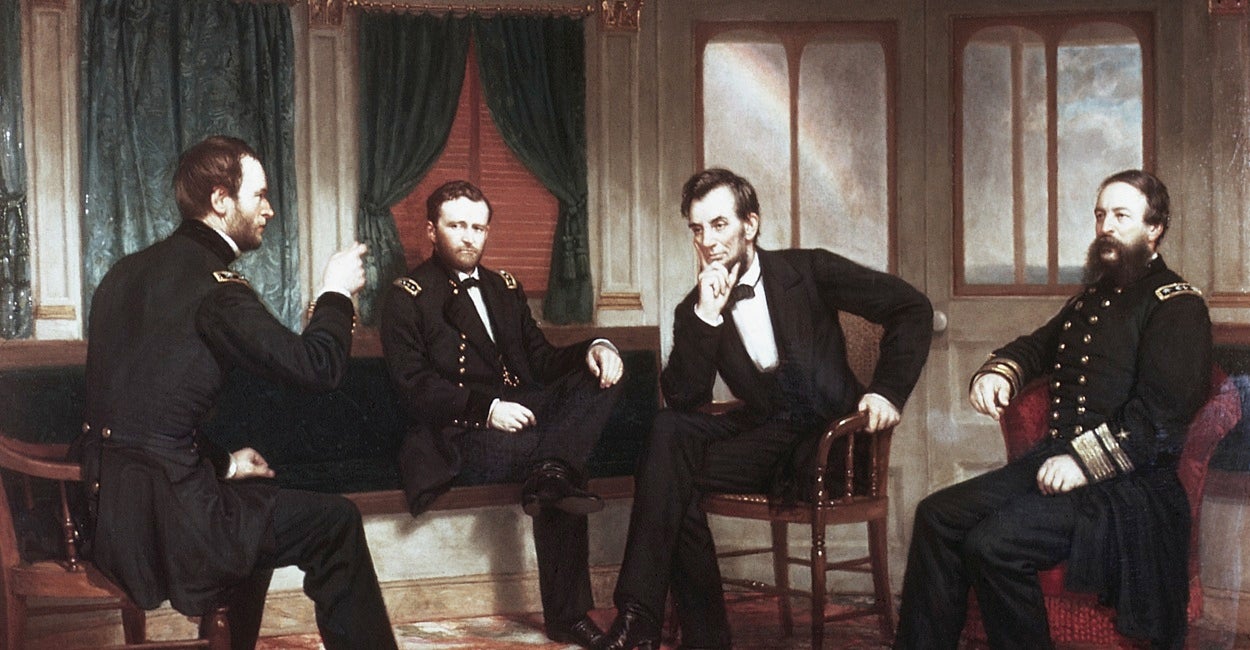
On April 14, 1865, President Abraham Lincoln was shot in the head and killed by John Wilkes Booth at Ford’s Theatre during the showing of “Our American Cousin.” It was Good Friday.
It is eerily fitting that the murder occurred on the most somber day of the Christian year. Lincoln mentioned God frequently in his presidency, and his journey with God was deeply connected to the gravity of his work during the Civil War.
Between his election in November 1860 and his inauguration in March 1861, several southern states seceded from the Union. In Lincoln’s First Inaugural Address on March 4, 1861, he spoke about how the nation must be firm in faith: “Intelligence, patriotism, Christianity, and a firm reliance on Him, who has never yet forsaken this favored land, are still competent to adjust, in the best way, all our present difficulty.”
Here Lincoln showcased his distinctively American spirit. He believed that our nation was built on faith as well as love for both neighbor and country. Those qualities, in his view, can sustain the American people during tumultuous times.
In September 1862, during one of the most personally challenging parts of the Civil War, Lincoln wrote a private “Meditation on the Divine Will.” The Union had recently lost the Second Battle of Bull Run, and there were immense challenges ahead for the president. The country was tiring of the war. The growing death toll weighed heavily on the president. Had the time come to end the war?
According to one of his White House secretaries John Hay, the letter was the president’s way of working through his confusion and stress about the most important decision of his life. Hay also noted that this letter was not meant to be seen by men, which is why we have only one section. Lincoln writes:
“The will of God prevails. In great contests each party claims to act in accordance with the will of God. Both may be, and one must be, wrong. God cannot be for and against the same thing at the same time. In the present civil war it is quite possible that God’s purpose is something different from the purpose of either party — and yet the human instrumentalities, working just as they do, are of the best adaptation to effect His purpose. I am almost ready to say that this is probably true — that God wills this contest, and wills that it shall not end yet. By his mere great power, on the minds of the now contestants, He could have either saved or destroyed the Union without a human contest. Yet the contest began. And, having begun He could give the final victory to either side any day. Yet the contest proceeds.”
The words above are filled with religious significance and depth. They relate the broken heart of a man—and a president—for his fellow countrymen.
Faith demands that we be utterly honest with both ourselves and God. Lincoln’s meditation was more than a mere method to inform the president’s decision making; it was itself a prayer.
First, Lincoln writes that God’s will is victorious. To understand what that means for him, Lincoln then references a philosophical idea called “the principle of noncontradiction.” Most famously explained by Aristotle, the principle holds that two opposing claims cannot both be true in the same way at the same time. Therefore, either the south was right that human beings are not equal, and some can thus be owned by others. Or the north was right that the expansion of slavery—even its existence—is immoral because all human beings have dignity.
Second, Lincoln writes that the outcome of the war might be different from what either side hopes for. God often works in unexpected ways. God’s logic often makes itself known through challenging and confusing times. Though painful, this can ultimately teach us to rely on God and trust that providence will lead us through.
Finally, the president’s meditation on God’s will does not seem to have resolved all Lincoln’s confusion. The war must continue, for now. This brings him much grief, but he knows that it is right.
Our own prayers often mirror Lincoln’s. We ask God for help, healing, or to change our circumstances, but we know he is unlikely to remove our suffering immediately. When there is no clear solution or instant change at hand, the only thing we can do is act in the truth, be committed to justice, and rely on God.
Although Abraham Lincoln is most famous for his dramatic public actions and speeches, this quiet, prayerful resignation to the will of God is part of his legacy too.
Our true colors emerge when we are faced with great challenges. Lincoln turned to God. May we follow his lead in doing the same during our own trials as well.
We publish a variety of perspectives. Nothing written here is to be construed as representing the views of The Daily Signal.