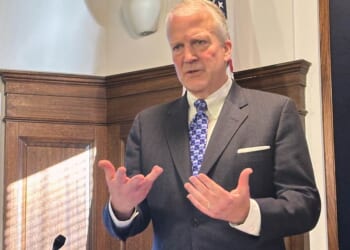

FIRST ON THE DAILY SIGNAL — Indiana Sen. Jim Banks urged the Federal Trade Commission on Monday to investigate abortion drug manufacturers and distributors for potentially false or misleading medical and safety claims.
In a letter to the FTC, Banks called on the commission to uphold federal prohibitions against deceptive trade practices by holding abortion drug companies to the same standards as other companies.
“Mifepristone manufacturers and dispensers continue to mislead pregnant women into thinking that abortion drugs are much safer than they really are, and that even if something bad does happen, they can receive appropriate treatment without disclosing their abortion,” the letter stated.
“Companies that profit from abortion drugs should be honest about their risks,” the letter added. “The FTC has the tools in its toolbox to hold abortion drug companies to their obligations under consumer protection law.”
Banks said that medication abortion, involving the drugs mifepristone and misoprostol, accounts for nearly two-thirds of all abortions in the United States. He noted that these drugs are often prescribed online, without in-person screening for dangerous complications such as ectopic pregnancy. They are then shipped nationwide, including into states that have restricted abortion.
Banks took issue with marketing claims that mifepristone is “safer than Tylenol” or other common over-the-counter medications.
“There is no scientific basis for the claim that mifepristone is ‘safer than Tylenol,’” Banks wrote, arguing that such claims lack the standards of controlled studies and could thus constitute deceptive trade practices under FTC precedent.
Banks’ letter cites a report by the Ethics and Public Policy Center that, according to insurance claims data, more than 10% of women who take the abortion pill experience serious adverse events, including hemorrhaging and sepsis.
The letter references the death of Amber Thurman, a 28-year-old Georgia mother who died after suffering septic shock “due to complications from mifepristone.”
Some clinics advise women to tell emergency room staff they are experiencing a miscarriage rather than disclose an abortion, while asserting—without proper evidence, the letter says—that the treatments are the same for both.
“According to various clinics, women who receive emergency treatment following a chemical abortion can get the care they need without mentioning the abortion,” Banks stated. “Some clinics even claim that the treatment for chemical abortion complications is the same as treatment for miscarriage.”
The senator emphasizes that federal law, as interpreted by the Federal Trade Commission, prohibits claims “that are likely to reasonably mislead consumers to their detriment.”