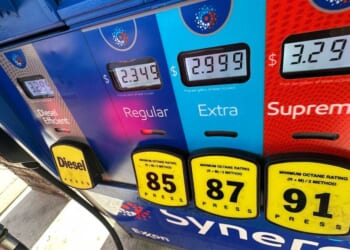

Iran knows America’s weak point. It is not the Strait of Hormuz. It is the gas pump. Washington has the tools to close that vulnerability. It has simply refused to use them.
The consequences of that refusal are playing out at every gas station in America. Gasoline has risen to $4.52 a gallon from $3.10 before the war. Diesel is at $5.80, up from $3.50. Jet fuel has hit $7.00. Oil producers and refiners are reaping an estimated $254 billion of wartime profits annually.
Every dollar above pre-war fuel prices transfers directly into political pressure accumulating in congressional offices, presidential approval ratings, and midterm election calculations.
Iran does not need to win a single military engagement. It needs only to keep the strait closed long enough for consumers, farmers, truckers, and builders to demand a premature end to the war, one that would leave U.S. strategic and nuclear objectives unfinished and signal weakness to Russia and China.
Tehran is running the clock. The administration understands this. Strategic Petroleum Reserve releases have been deployed and an 18 cent per gallon federal gas tax holiday has been proposed. Unfortunately, neither of these measures will meaningfully move pump prices. The political problem Iran is exploiting requires a significant solution at the pump, not at the margins.
Two additional responses have been proposed. Both are faulty.
Progressives argue that oil producers and refiners are collecting windfall profits they did nothing to earn. Their diagnosis is accurate. Their cure is not. A windfall tax redirects the transfer from the oil industry to the federal treasury. The consumer still pays $4.52 at the pump this morning and receives a modest quarterly rebate months later. Too small, too slow, and too diffuse to reduce the political erosion that Iran’s strategy requires.
Free-market conservatives argue that price controls distort markets, destroy production incentives, and produce the gas lines that characterized the 1970s energy crisis. As an energy regulator during those years, I can attest that this principle is sound economics in normal times. But these are not normal times, and the historical analogy does not hold.
The 1970s controls failed because they pushed crude prices below the cost of production, eliminating the incentive to supply the market. That failure was rooted in genuine domestic scarcity. America then was a net importer with no buffer against a supply shock. America today is the world’s largest oil producer and a net exporter. The underlying condition that made controls catastrophic then simply does not exist now.
Not a single Permian Basin well costs more to operate than it did in January. Not a single pipeline tariff has increased. Not a single refinery has spent an additional dollar processing domestic crude. The entire $1.40 per gallon increase in gasoline and $2.30 per gallon increase in diesel is traceable to a geopolitical shock, not marketplace costs. What is being removed is not the producer’s margin but the foreign-crisis premium that the Brent benchmark is imposing on American consumers for a supply shock they are not experiencing.
There is a straightforward and administratively easy remedy. Regulate the purchase and sale price of oil to and by the nation’s approximately 130 domestic refineries, and regulate their export volumes in order to assure that American consumers are supplied first. Producer prices are capped at the pre-war level of $65 a barrel, the marginal cost of WTI oil, the price that has fueled the explosion in oil production and profits, while exports continue at full world prices. No one sells below cost. Pump prices return to $2.80 to $3.25 a gallon. Diesel falls from $5.80 to $3.50. The regulation terminates automatically once the IRGC is defeated and the WTI-Brent spread returns to its pre-war level of roughly $4.00 per barrel.
Iran’s calculation is a race against the American political clock. Every week gas stays above $4.50, that clock runs faster. A president who removes the consumer price shock removes Iran’s most powerful weapon. An American public paying no more than $3.25 a gallon is far more willing to see this conflict through to its conclusion than one paying $4.52.
Some who support the war most vocally also invoke free-market principles as grounds for government inaction. That combination, however principled in normal times, is handing Tehran exactly the political conditions it needs. Supporting the war while refusing to remove its economic sting is not a strategy. It is a contradiction.
The free-market purists are applying a peacetime principle to a wartime emergency. The windfall taxers are solving the wrong problem for the wrong beneficiary. Both positions serve Iran’s strategic interests by leaving pump prices intact and American consumers angry.
Tehran is counting on Washington’s paralysis as politicians jockey for political and electoral advantage. Whether it continues is entirely in American hands. Washington must unite to win this war, eliminate the threat of a nuclear-armed Iran controlling 20% of the world’s oil supplies, and prove that America is still the greatest military and economic power in the world.
David S. Cohen served as chief attorney and chairman of the New Mexico Public Service Commission. He has over three decades of experience in the oil and gas industry.
This article was originally published by RealClearEnergy and made available via RealClearWire.