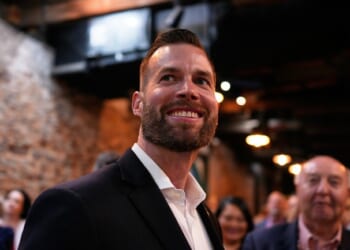

It’s a fight over whether a Christian organization, Liberty University, is allowed to fire a man who took a job as a man, signed a doctrinal statement affirming the significance of and agreeing to abide by biblical beliefs and standards, then reneged on his promise and was fired.
LGBT activists claim it’s a fight between the man’s transgender rights and the religious rights protections afford by the Constitution to the school, but there’s more to it than that.
It was Jonathan Zinski who was hired at Liberty for a tech job, and as part of the job process signed a doctrinal statement required by the school. Immediately after a 90-day probationary period passed, he announced that he was now a woman, and would identify as such.
He was fired for going against the doctrinal statement he signed.
A report from WSET-TV said oral arguments were Tuesday before the 4th U.S. Circuit Court of Appeals.
Zinski, now going by “Ellenor,” sued after he was fired. Media reports constantly explain that the dismissal came right after he came out “as transgender,” and leave out the part about him abrogating the doctrinal statement he signed.
The ACLU, working on Zinski’s behalf, claimed his job did not fall under the “ministerial exception” which constitutionally allows religious organizations to require a certain level of employee to share the organization’s beliefs.
The ACLU’s Matthew Callahan told the court he wants a ruling that, “There’s a protected class of people who are the messengers of faith who do the religious duties, but for their groundskeepers, for their janitors, for their IT apprentices, they are still subject to federal law.”
Liberty Counsel founder Mat Staver explained that exception applies to Zinski.
“The ministerial exception has been broadened beyond pastors, clergy, rabbis, to other individuals that perform what’s called a ministerial function. We believe in the IT department that’s exactly what Zinski performs. And so, Liberty’s decision was clearly protected by the First Amendment,” Staver said.
The report noted former U.S. attorney John Fishwick said the fight was a clash over rights.
“It’s basically a constitutional showdown between two rights. The right to protect yourself from discrimination in the workplace versus Liberty’s right to religious freedom and the way to conduct their school,” he said.
The ACLU said, “No one, including transgender employees, should be fired because of who they are.”
But Staver pointed out the First Amendment’s religious rights protections date to the founding of the nation.
An LGBT-leaning publication said Zinski now has “left the U.S. just for my safety.”
Zinski told the publication he’s pained by the school’s confirmation that he “hoodwinked” the school,
“She (sic) said she (sic) was already navigating her (sic) gender identity when she (sic) was hired and disclosed it to colleagues she (sic) trusted, all while continuing to perform her (sic) job,” the reporting said.
According to the Washington Examiner, the statement that Zinski voluntarily signed at the beginning of his employment “included a pledge to reject a litany of practices that contradict Christian teachings, including ‘denial of birth sex by self-identification with a different gender.’”
Staver set the case was orchestrated to create the conflict.
“Jonathan Zinski clearly set up Liberty University because he was taking the female hormones, he falsely affirmed the doctrinal statement, and then when he was terminated, he got the help of the ACLU,” he said.
The report said, “Staver noted that shortly before Zinski applied, Liberty University hosted a speaker at its convocation who talked about how God created us in His image: male and female. The female pastor at Zinski’s church attended Liberty University’s convocation and was upset by the speaker’s message.”
“Then guess what happens? Lo and behold, Jonathan Zinski pops up, and he applies to Liberty University,” Staver said. “I think there’s clearly issues here with Zinski setting up Liberty and wanting to take down one of the largest Christian universities in the country.”
ACLU Tries to Tell Christian Institution Which Sins It Should Allow
In our Zinski v Liberty Univ. case, the court effectively ordered this private Christian university to change its doctrine.
I covet your prayers on this critically important case.
Mat Staver
Liberty Counsel pic.twitter.com/CemsxrllIa— Liberty + (@dmills3710) August 8, 2025
Liberty University is seeking dismissal of a lawsuit filed by former employee Ellenor Zinski.
Zinski was hired as a man but came out as a woman in 2023. She was subsequently terminated for “open violation of Liberty University’s doctrinal statement.”https://t.co/crN5m9ZacL
— 7News DC (@7NewsDC) October 1, 2025
Mat Staver lays out why this SPLC-backed lawsuit was a set-up, how Title VII, RFRA, and the First Amendment protect LU, and why Liberty Counsel is willing to push this case all the way to the Supreme Court for the cause of religious liberty.https://t.co/er4syMsGIB
— Liberty Counsel (@libertycounsel) May 28, 2025
We filed two letters of supplemental authority to the Fourth Circuit Court of Appeals in Zinski v. Liberty University regarding recent court decisions out of Washington and Minnesota that uphold the right for religious institutions to employ people align with their beliefs.…
— Liberty Counsel (@libertycounsel) January 16, 2026
The circumstances are not identical but when Colorado repeatedly attacked Christian business owners, a bakery artist and a web designer, demanding they violate their Christian faith in order to abide by a state non-discrimination requirement, the Supreme Court twice ruled in favor of faith, determining that the state could not force people to violate their faith.
That stunt by leftist officials in the state cost millions of dollars in legal fees paid by the loser in both cases.