
I have exciting news. Do you remember a long time ago, when the famous atheist professor Will Provine invited Michael Behe to make the case for intelligent design at Cornell University? Well, 22 years later, Behe has returned to Cornell, to give a lecture to students and answer questions. Let’s find out what Behe’s arguments were and whether any biologists showed up to stump him.
So, it’s always fun to start with the announcement of the event. I like to support these events because I am very passionate about events on campus where students are presented with evidence that will help them to form more accurate views about the big questions of life.
So, here is the link to the event announcement, and it says:
Throughout history, most people, including most scientists, thought that the intricate mechanisms of life were purposefully designed. The design hypothesis fell out of favor in academia after 1859, the year Charles Darwin instead proposed that life evolved by utterly unguided random variation sifted by natural selection. In the past 75 years, however, much has been learned about the molecular basis of life that was completely unknown in Darwin’s era. In my talk I will argue that the astonishing discoveries of modern biochemistry require a reversal of our evaluation of Darwin versus design: the conclusion that, in large part, life was purposely designed has once again become rationally compelling.
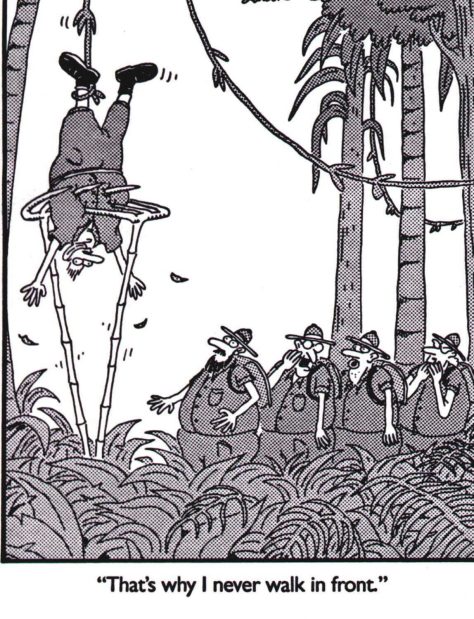
I would like to get my hands on the slides for this lecture. Roger Pielke just gave a talk at Cornell earlier this month, and he posted his slides. Maybe I can get Mike to do the same. If you have ever seen one of his lectures, he actually has fun slides – he puts Far Side cartoons into his lectures to keep people paying attention.
Anyway, here is the audio from the talk, and here are his main arguments: 1) irreducible complexity and 2) Darwinian mechanisms cannot create new forms over time.
But he actually made 5 points in the presentation:
- Design is NOT mystical – it is a normal empirical conclusion from physical evidence
- Everyone (even Richard Dawkins) admits biology appears to be designed.
- The progress of science has revealed structural obstacles to Darwinian explanations (irreducible complexity “Darwin’s Black Box” and the discovery that most observed beneficial mutations break genes “Darwin Devolves”).
- Darwinian claims still rest on imagination and “just-so stories”.
- We have strong evidence for real design but almost no evidence that Darwinism can build complex molecular machines.
What was interesting about this podcast? Well, like I said, I am really, really committed to helping students to hear two sides to the big questions of life. Most of the college students that I talk to in the workplace explain to me that their process of forming their worldviews was two-fold: 1) I wanted to have fun, and 2) I wanted the smart people (professors) to like me. It was just easier for them to accept certain beliefs in the college environment, and that’s why they accepted them. A lot of things that are false are just easier to believe for social or professional reasons: the universe is eternal, the origin of life is a solved problem, the fossil record shows gradual increases in complexity, the genome is 90% junk DNA – just complete nonsense. And the best way for them to correct these false beliefs is to bring an honest scholar like Mike Behe or Mike Licona to speak about evidence at the local university campus.
The podcast is fun because they really explain all the details of what happened. Who invited Behe to speak? Where did Behe speak? Who did Behe speak to? Were biologists invited? Did any biologists show up to confront Behe? How long was the talk? How long was the Q&A? Was the tone of the Q&A calm or argumentative? Did the Q&A stop because no one had questions, or was there a long line of people waiting to ask more questions?
Confronting naturalism on campus
I have a friend named Stephanie who just loves all sorts of protests and gatherings and marches. But for me, this is much better. Instead of people yelling at each other over politics, we can actually have some evidence presented, and minds can change. Maybe not right in the moment, but afterwards. This worked well for me when I was in my 20s. I used to order dozens and dozens of lectures and debates from university campuses from places like Veritas Forum and Access Research Network. I would listen over and over, and then when I tried out the evidence on co-workers (and I mean people with graduate degrees from good schools like UIUC and Purdue and Northwestern) they always had to concede. There is just something about being able to listen to Christians speak about evidence to college students – it’s just the right level of difficulty for software guys like me to understand it and learn how to speak like that. And this led to a lot of adventures.
Secrets of the Cell with Mike Behe
Well, if you listen to the podcast, and you like it, and you want to try to explain Michael Behe’s arguments to college students yourself, he does have quite a good series of lectures posted on YouTube:
- Someone Must Have the Answer! (Secrets of the Cell, Ep. 1)
- The Complexity of Life (Secrets of the Cell, Ep. 2)
- Bugs with Gears (Secrets of the Cell, Ep. 3)
- The Effects of Mutation (Secrets of the Cell, Ep. 4)
- The X Factor in Life (Secrets of the Cell, Ep. 5)
- Bacteria: Superheroes of the Microbial World (Secrets of the Cell, Ep. 6)
- Blood Clotting: The Body’s Emergency Response System (Secrets of the Cell, Ep. 7)
- Michael Behe Unravels the Mystery of Biological Information (Secrets of the Cell, Ep. 8)
- The Robot Repairmen Inside You (Secrets of the Cell, Ep. 9)
Everything is so much easier now than it used to be for me in the old days. You guys don’t have to rewind VHS tapes and audio cassettes like I used to have to do! And if you hear a word or phrase that you don’t understand, just ask Grok to explain it to you like it would explain it to a high school student. Anyway, have fun.