Read Hanne’s The Herland Report.
We are living through a geopolitical-economic shift, emphasizing the United States’ evolving role in global energy security. The U.S. now moves to replace British City of London’s speculative financial and globalist free-trade dominance with a new global order anchored in tangible industrial power and national sovereignty.
The emerging new economic paradigm is based on sovereign nation-state collaboration, rooted in shared industrial-economic traditions. This leavesglobalist “green energy / soft power” Europe in a limbo. The decline of the post-WWII transatlantic alliance is exemplified by NATO and G7 decision not to help secure the Strait of Hormuz in the current Iran conflict, the critical chokepoint between Iran and the Gulf States, responsible for 20% of the world’s oil trade.
Mark that the U.S. is self-sufficient with 12 million oil barrels in daily production, so is Russia with 11 million barrels a day. Whoever controls the Strait of Hormuz, controls the choke hold of energy supplies from the Arab States and Iran to India, China and the whole Southeast Asia. China alone imports approximately 11 million barrels a day, of which 60% comes from Saudi Arabia, Oman, Iran and UAE through the Strait of Hormuz. Approximately 84% of the oil that goes through the Strait goes to Asia, divided between China, India, Japan and South Korea.
The growing U.S. control over global energy security has direct links to the Venezuela situation where most of its oil went to China. And before that, the Panama Canal controversy where the canal was basically controlled by China in America’s backyard. The ongoing time-limited conflict in Iran is but the next step in the same direction, as most of Iran’s energy supplies fuel China, paid in yuan not the dollar. Trump mulls Cuba is next.
The crisis over the control over the Strait of Hormuz is yet another stepping-stone for the U.S. to weaken its adversaries. It is also backed by regional Gulf allies who do not want Iran to control their backyard and now consider a pipeline to avoid the Strait altogether.
To achieve an “America First” economic turnaround at home, the international power game must shift in America’s interest. Domestic growth is intrinsically connected to securing strategic interests internationally. You cannot achieve one without the other. This is what local American podcasters like talkative Tucker Carlson cannot understand, in his inability to comprehend how the international world works. Due to his naiveté and incompetence in the global field and thereby reliance on third-party sources, he is easily lured into serving the globalist mainstream agenda. Tucker Carlson has become the top Democrat tool to divide the MAGA movement in the hope of crushing President Trump’s “America First” agenda.
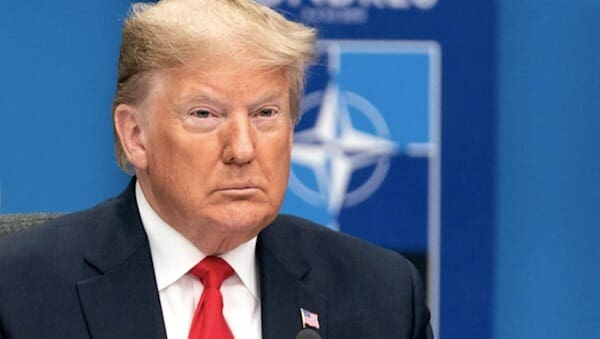
As President Trump recently criticized NATO for failing a critical test by not coming to help secure the Strait of Hormuz, he implied that the U.S. may no longer feel obligated to defend its European allies due to their inadequate support. Trump stated that in the war on European soil between Ukraine and Russia, the U.S. came to Europe’s aid. When America asked for help to safely escort ships through the Strait, the Europeans refused. Europe does not want to help its allies secure the world’s most critical energy strait when in crisis.
“This marks the funeral of the transatlantic order, with NATO and the City of London’s financial dominance regarded as obsolete. The City of London’s Pretorian Guard is finished as strategic partners,” says Barbara Boyd, writer, paralegal and head of the Promethean Action who has tracked the imperial great game for decades.
Boyd’s point is that the Iran conflict is not only a regional Middle Eastern crisis, but a financial war and a systematic dismantling of the British imperial financial system, especially City of London’s control over global insurance and commodity markets.
The City of London’s financial hegemony – the British empire’s financial weapon – has been dominating the West for decades. London’s historical dominance in maritime insurance and financial risk control is now being replaced by the U.S. Development Finance Corporation (DFC) working with U.S. Central Command. U.S. government agency is now underwriting maritime trade insurance in the Gulf, replacing Lloyd’s of London. This shift undermines City of London’s 300-year-old control over global maritime trade insurance, signaling a structural economic transition of massive dimensions. United States Secretary of Treasury Scott Bessent recently described the shift.
Capital is now flowing into physical American industries such as energy, mining, manufacturing, nuclear power and defense, highlighting a shift from globalist financial speculation to tangible economic productivity in America, not only in China. This is precisely what America First was all about.