

America’s workforce is under pressure, not just from automation and global competition, but from federal immigration policies that have quietly incentivized employers to favor temporary foreign labor over hiring Americans. From H-4 spousal work permits to student visa work training (OPT/CPT) to H-1B guest workers, these policies erect structural advantages for non-Americans that depress wages, reduce job prospects for citizens and enable discriminatory hiring and offshoring.
Do H-4 spouses represent unfair competition?
A federal lawsuit challenging recent changes to work authorization rules for holders of H-4 visas (which allow spouses and under-21 unmarried children of H-1B visa holders to live and work in the U.S.) has renewed attention on a broader issue long raised by labor economists, regulators and displaced workers: Multiple U.S. visa programs authorize employment without requiring employers to test the domestic labor market, creating major structural disadvantages for American workers.
The case, Doe v. DHS, filed Jan. 8, challenges a Department of Homeland Security interim rule that ended automatic extensions of Employment Authorization Documents (EADs) for H-4 spouses of H-1B visa holders. While the plaintiffs argue the change harms immigrant families financially, the lawsuit highlights how H-4 employment authorization itself operates outside the safeguards typically applied to U.S. hiring.
H-4 employment authorization: work access without labor protections
H-4 visas are issued to dependents of H-1B workers. Unlike the H-1B program itself, H-4 employment authorization does not require employers to:
- Conduct labor market recruitment
- Test whether qualified U.S. workers are available
- Certify prevailing wage compliance
- File labor condition applications tied to the job
Employment authorization for H-4 holders was created through administrative action rather than statute. The Department of Homeland Security began issuing H-4 EADs in 2015, expanding the authorized labor pool without adding corresponding worker protections. Policy analysts have noted that this creates a class of workers legally permitted to work while remaining outside core labor-certification frameworks. As a result, employers may hire H-4 workers without demonstrating that no qualified American worker is available, a requirement that exists in other employment-based immigration programs.
Foreign employment authorization with major cost advantages
Similar structural issues exist in Optional Practical Training (OPT) and Curricular Practical Training (CPT) programs, which authorize employment for foreign students.
Under OPT and CPT:
- Employers are exempt from paying Social Security and Medicare taxes
- Workers are exempt from payroll contributions that apply to U.S. employees
- No labor market test is required before hiring
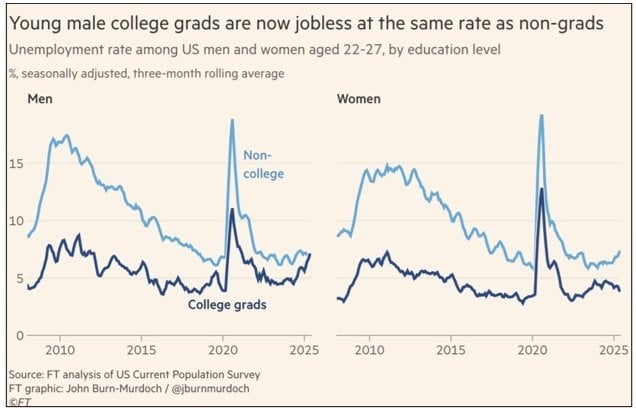
These exemptions reduce employer labor costs by more than 15% compared to hiring U.S. workers. Academic research cited by Georgetown University has found that OPT workers earn substantially less than similarly situated U.S. workers, indicating wage-based substitution rather than skills shortages.
Because these programs primarily operate in early-career professional fields such as technology, engineering and finance, American graduates compete directly with a workforce that is legally cheaper to employ.
H-1B and labor arbitrage models
While the H-1B program includes wage and attestation requirements, it remains closely associated with labor arbitrage and offshoring business models, particularly in the technology and staffing sectors.
Public reporting and policy reviews have documented that:
- H-1B workers are often paid below local median wages
- Staffing firms use visa pipelines to support offshore delivery models
- Employment frequently transitions from U.S.-based roles to overseas operations
These practices reduce long-term domestic job creation and weaken wage growth for U.S. workers, particularly in mid-career technical roles.
Analysis of USCIS employment approvals shows major expansion of authorized labor
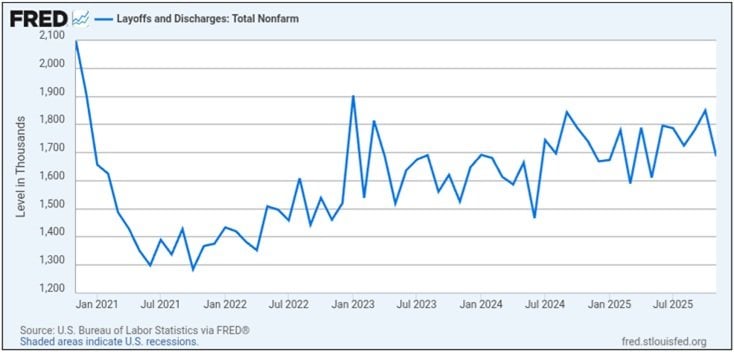
Data released by U.S. Citizenship and Immigration Services (USCIS) shows that more than 9.3 million employment-related approvals were issued between fiscal year 2022 and the third quarter of fiscal year 2025, a period that coincided with widespread layoffs across the U.S. economy.
The data, drawn from USCIS’s “All USCIS Application and Petition Form Types (Fiscal Year)” tables, reflects approvals for work authorization documents (EADs) and employer-sponsored nonimmigrant worker petitions, both of which permit individuals to enter or remain in the U.S. workforce.
The USCIS forms included in the employment-based totals fall into two categories with direct labor market impact:
1. Open-market work authorization
• Form I-765: Application for Employment Authorization is used to request an Employment Authorization Document (EAD) from the U.S. Citizenship and Immigration Services, and applies to H-4 spouses, OPT, CPT, TPS, parole-based EADs and “Adjustment of Status” applicants who are permitted to work while green card cases are pending.
These approvals allow individuals to work for most U.S. employers without sponsorship and generally do not require employers to conduct a labor market test.
2. Employer-sponsored nonimmigrant workers
• Form I-129: Petition for a Nonimmigrant Worker includes H-1B, L-1, O-1, TN, E-3 and related categories and authorizes employment tied to specific positions.
Together, these approvals represent the flow and retention of authorized foreign labor in the U.S. economy.
Aggregate totals (FY 2022 through Q3 FY 2025)
USCIS approval totals for the period show:
- Employment Authorization Documents (EADs): 7,216,116
- Nonimmigrant worker petitions (I-129): 2,110,994
Combined total: 9,327,110 approvals authorizing employment or continued employment in the United States over approximately 3.75 fiscal years.
These figures represent workers legally authorized to compete in the U.S. labor market, not dependents or visitors without employment rights.
EAD approvals dominate employment growth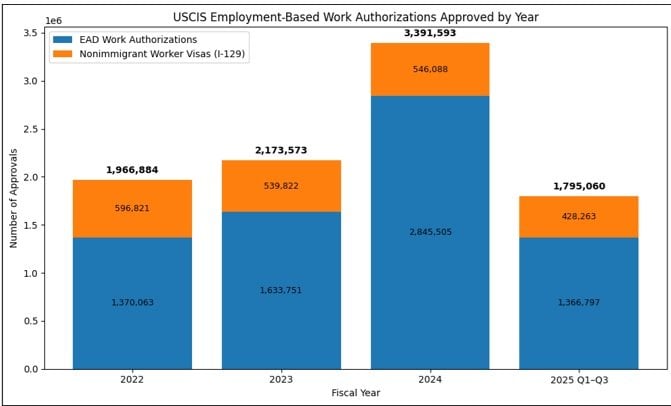
Across the full dataset:
- 77% of employment-related approvals were EADs
- 23% were employer-sponsored nonimmigrant petitions
This indicates that open-market work authorization, rather than job-specific sponsorship, was the primary driver of authorized labor expansion during this period.
EAD holders may generally:
- Work for any employer
- Change jobs without restriction
- Be hired without sponsorship costs
For most EAD categories, employers are not required to demonstrate that U.S. workers were unavailable.
Composition of EAD approvals within EAD approvals:
- “All Other” EADs: 4,901,426
- Adjustment of Status EADs: 2,314,690
Approximately two-thirds of all EADs fell into the “All Other” category, which includes H-4 spouses, OPT, CPT, TPS and parole-based employment authorization. These categories represent net additions or retained labor in the competitive job market rather than transitions from existing U.S.-based employment.
Labor market implications reflected in the data
The USCIS data shows that:
- Employment authorization expanded during a period of labor market contraction
- Growth was concentrated in categories without labor market testing
- Open-market work authorization significantly outpaced employer-sponsored hiring
From a labor market mechanics perspective, increasing labor supply during periods of reduced demand creates additional competition for available positions and exerts downward pressure on wages.
Context for ongoing policy and legal debates
The data provides context for current litigation and policy discussions surrounding employment authorization programs, including those related to H-4 dependents and other EAD-based categories.
While legal challenges often focus on individual programs, the USCIS figures demonstrate that employment authorization operates as a cumulative system, with combined effects that materially shape labor market conditions.
Between fiscal year 2022 and the third quarter of fiscal year 2025, USCIS approved more than 9.3 million employment-related applications that allowed individuals to enter or remain in the U.S. workforce.
The majority of those approvals involved open-market work authorization rather than job-specific sponsorship, coinciding with a period of mass layoffs and reduced hiring across multiple U.S. industries.
Documented effects on American workers
Across H-4, OPT, CPT and H-1B programs, the structural impacts on the domestic workforce are consistent and measurable:
- No labor market test: Americans are not guaranteed consideration
- Lower labor costs: Visa workers cost employers less by design
- Reduced bargaining power: Temporary status increases employer leverage
- Wage suppression: Documented evidence shows downward pressure on wages
- Job displacement risk: Particularly in technology and professional services
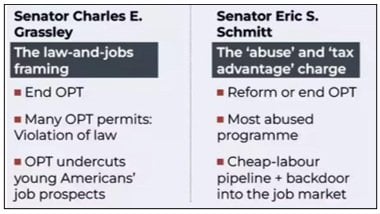
Sen. Chuck Grassley and other lawmakers have repeatedly warned that employment-based visa programs must not be used to displace U.S. workers or suppress wages, citing gaps in enforcement and transparency.
Broader implications: Discriminatory hiring risks
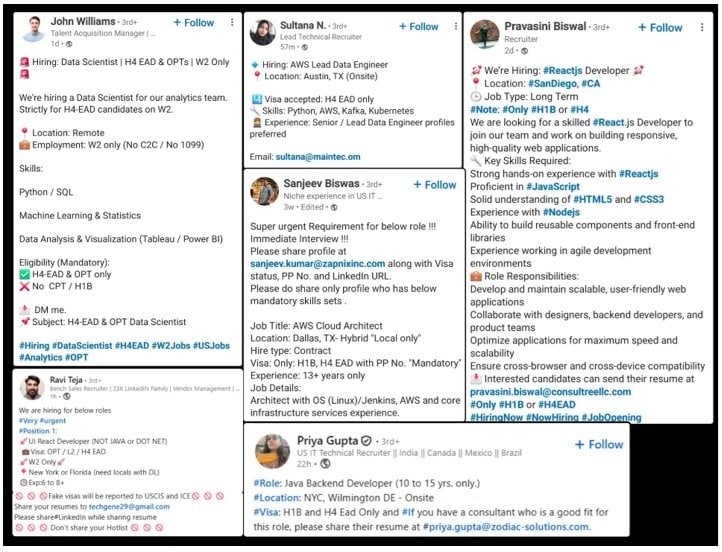
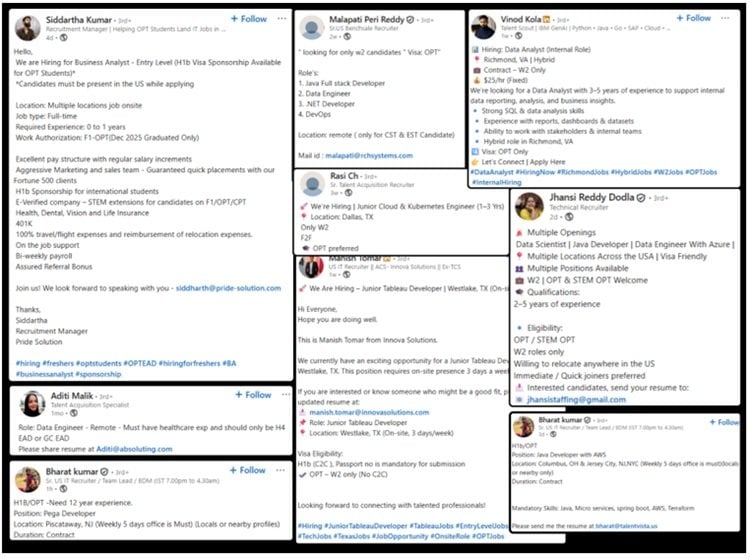
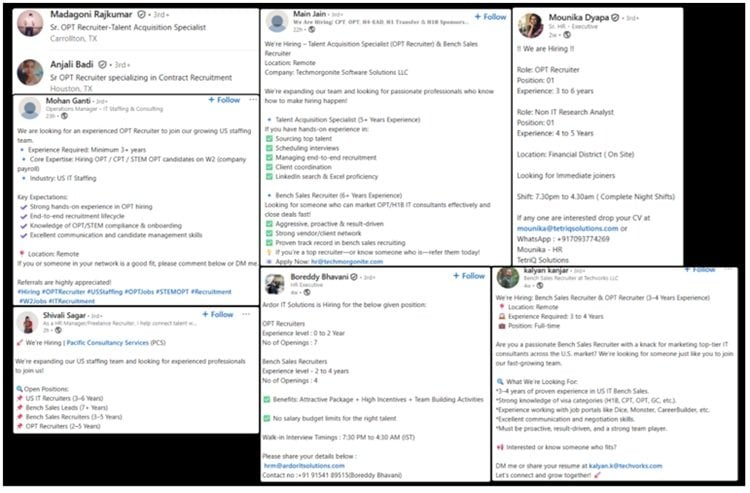
Labor arbitrage associated with visa-dependent hiring models has been widely documented, particularly in connection with H-1B-dependent staffing firms. Public reporting and regulatory reviews have identified recruitment practices that rely on closed hiring networks and layered subcontracting arrangements, which limit open competition in the labor market.
These models are also used to support onshore-offshore delivery structures, enabling knowledge transfer from U.S.-based roles to overseas operations and contributing to the migration of jobs outside the United States.
The effects of these practices are compounded when employment authorization is granted without independent labor market verification, as occurs in programs such as H-4 employment authorization, Optional Practical Training (OPT) and Curricular Practical Training (CPT). In these cases, employers may hire authorized workers without demonstrating that qualified U.S. workers were unavailable, increasing the risk of labor substitution and wage pressure in affected sectors.
Policy focus: Workforce protection vs. workforce expansion
The lawsuit challenging DHS’s recent rule change centers on work authorization continuity for H-4 holders. However, the broader policy question remains unresolved: Should employment authorization programs expand without requiring employers to prove that American workers are unavailable or unwilling to fill the same roles?
Current federal policy allows multiple visa categories to bypass that question entirely. As lawmakers and courts consider the future of employment-based immigration, the measurable impacts on American wages, job access and labor standards remain central to any evidence-based reform discussion.