The White House’s long-awaited draft of the National Framework on Artificial Intelligence requires protections for children online, but some child safety advocates are looking for more.
“Al services and platforms must take measures to protect children from potential harms, while empowering parents to control their children’s digital environment and upbringing,” a draft obtained by The Daily Signal reads.
The draft framework is intended to provide a template for federal legislation. This is the first time the White House has developed a framework for protecting kids online with respect to AI.
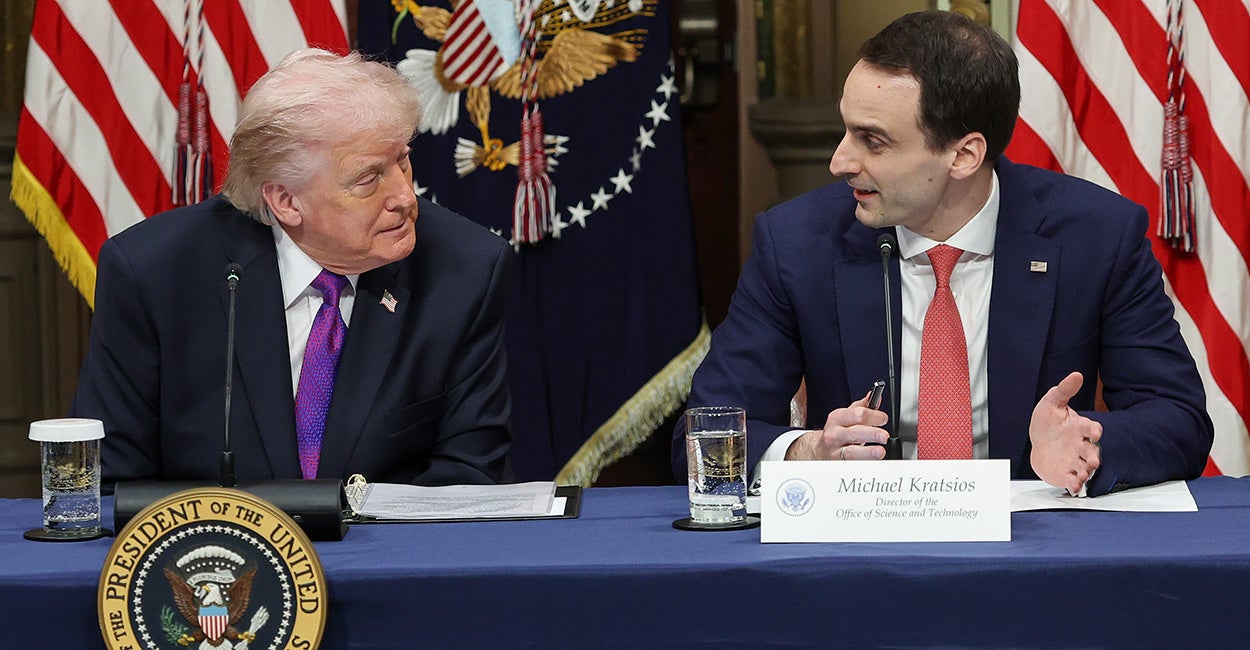
“We need one national AI framework, not a 50-state patchwork,” Michael Kratsios, science and technology adviser to the president, told The Daily Signal in an exclusive interview. “And I think one of the key provisions of it that will make it all work and come together is really focusing on the bipartisan consensus around protecting America’s children.”
The framework is the product of weeks of bipartisan discussions with members of Congress.
“We really want to ensure that the Congress lays out specific standards and not ones that are ambiguous, and really provides the clarity necessary, so that parents do have these really important controls to be able to manage how their kids interact with the digital world,” Kratsios said.
President Donald Trump signed an executive order on Dec. 11 ordering the attorney general to establish an AI litigation task force that would challenge state efforts to regulate AI.
The president directed White House AI czar David Sacks and Kratsios to recommend federal AI legislation preempting any state laws in conflict with the administration’s policy.
The new draft framework tells Congress to ensure that it does not “preempt states from enforcing their own generally applicable laws protecting children, such as prohibitions on child sexual abuse material, even where such material is generated by AI.”
But child safety experts fear that any state law that refers to data, AI, or algorithmic systems could be considered not generally applicable since they apply to specific technologies.
It’s unclear if the provisions laid out in the framework will be enough for the child safety coalition to agree to preemption of state AI laws.
Daniel Cochrane, a tech policy expert at the Heritage Foundation, said the preemption could handicap states from addressing harms that “would endanger our kids and disable responsible AI governance essential for human flourishing.”
“States remain the American people’s first and best line of defense against Big Tech,” he told The Daily Signal.
Sen. Marsha Blackburn, R-Tenn., introduced her own AI framework on Wednesday, including her Kids Online Safety Act, which child safety advocates say invites the strongest protections for children. Nothing in her framework preempts states from enacting any laws, rules, or regulations that provide “greater protection to minors than the protection provided by the provisions of this title.”
The White House framework asks Congress to build on actions by the Trump administration to protect children from Al harms, including First Lady Melania Trump’s Take It Down Act, which protects children and adults from deepfake pornography.
“There was great bipartisan support for what the first lady was able to do with the Take It Down Act earlier this year,” Kratsios said. “And we think that there’s a lot of great provisions within our proposal that are going to be very important for parents who are looking out for kids.”
While this is a step in the right direction, child safety advocates hope Congress will address Section 230, a law that protects platforms for nearly all content they present to their users. The Take It Down Act criminalizes generating non-consensual sexual imagery, but this provision applies to individuals, rather than the platforms used to create the images.
The White House Office of Science and Technology Policy is also asking Congress to “empower parents and guardians with robust tools to manage their children’s privacy settings, screen time, content exposure, and account controls.”
“We want to ensure that parents are empowered to shape and protect their children’s digital upbringing,” Kratsios said.
Child safety advocates worry that shifting the burden from technology companies to parents may not be fully effective, as parents are often not equipped to combat Big Tech.
“Parental controls are extremely limited in the protection and oversight they can provide to parents to keep children safe from predators and dangerous content online,” Ethics and Public Policy technology scholar Clare Morrell said in a Congressional testimony.
An internal research study at Meta recently found that parental supervision and controls had minimal impact on kids’ use of social media. TikTok admitted in an internal document that “user research” shows that families don’t use parental controls and that the controls do not address parents’ top concerns, including “inappropriate content, offensive interactions, and lack of privacy.”
Kratsios said the White House prioritizes making sure that parents can control their child’s online experience.
“The first type of provision to do that at the most base level is an age assurance process for app stores, for example, so that parents can ensure that any apps that their children use are approved for minors,” he said.
“And the second thing, which I think is potentially even more important, is to provide parents with account controls to manage their children’s privacy settings, their screen time, their content exposure,” he added. “We want parents to be able to see, feel, and understand what their children are up to in this digital environment.”
The framework asks Congress to establish “commercially reasonable, privacy protective, age-assurance requirements (such as parental attestation) for AI platforms and services likely to be accessed by minors.”
Child safety advocates hope Congress will include a definition of “minors” in any national AI standard, as exists in Blackburn’s framework, to make sure everyone under 18 would be protected.
The framework also asks Congress to “require Al platforms and services likely to be accessed by minors to implement features that reduce the risks of sexual exploitation and self-harm to minors.”
While child safety advocates widely support measures to protect kids from sexual exploitation, they say Congress must address the design features that make platforms so addictive. Blackburn’s act, for instance, would require tech companies to limit addictive features such as infinite scrolling, auto-play, and rewards for spending time on the platform.
The framework also asks Congress to “affirm that existing child privacy protections apply to AI systems, including limits on data collection for model training and targeted advertising.”
“Existing” federal law may refer to the Children’s Online Privacy Protection Act, passed in 1998 and enforced in 2000, which applies if platforms have actual knowledge that a user is under 13 years of age.
Kratsios said the White House will be working with Congress to “ensure that the spirit of this proposal is brought to bear on an ultimate legislative solution.”