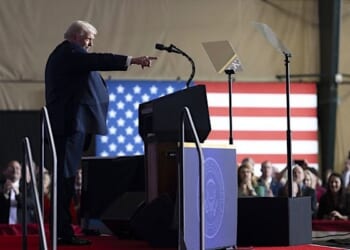
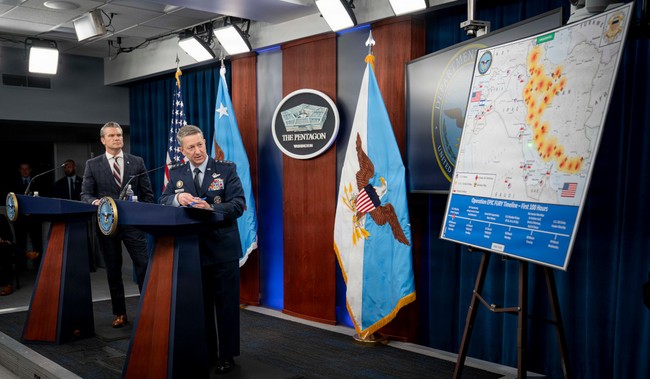
One thing the Iran War has demonstrated is that the overwhelming majority of journalists and commentators on the war are blindingly ignorant of the basics of military operations, they are unacquainted with the staff process, and they are so eaten alive by the all-devouring TDS virus that they have lost the ability to reason when Trump is involved.
The purpose of this post is not to declare victory, but to demonstrate that President Trump is leading a top-shelf strategic team put together by Secretary of War Pete Hegseth. He is getting good advice, he’s listening, and he’s making good decisions.
Friday, the Wall Street Journal reported what I think is a blindingly obvious example of how command and staff relationships work and how the commander-in-chief handles those relationships, and tried to portray it as a scandal or an example of recklessness.
Before the U.S. went to war, Gen. Dan Caine, the chairman of the Joint Chiefs of Staff, told President Trump that an American attack could prompt Iran to close the Strait of Hormuz.
Caine said in several briefings that U.S. officials had long believed Iran would deploy mines, drones and missiles to close the world’s most vital shipping lane, according to people with knowledge of the discussions.
Trump acknowledged the risk, these people said, but moved forward with the most consequential foreign-policy decision of his two presidencies. He told his team that Tehran would likely capitulate before closing the strait—and even if Iran tried, the U.S. military could handle it.
Now, two weeks into the war, Iran’s leaders have refused to back down, and the Strait of Hormuz has emerged as Tehran’s most potent leverage point.
Commanders command. Staffs advise. The purpose of a staff, and, if you haven’t picked up on it, the reason General Caine is the Chairman of the Joint Chiefs of Staff, is that he’s a staff officer. Trump is the commander because he’s the president. It is the staff’s job to present options to the commander and fully brief him on the advantages and disadvantages of each. It is the commander’s job to make the decision and provide the resources. If things go sideways, a military commander gets relieved, and a politician gets voted out. But at no point does the preference of the staff legally, morally, or ethically outweigh the right of the commander to make the call he determines is the best.
A commander is usually working with problems that the staff, outside the chief of staff, might be unaware of. Because, as Clausewitz said, “War is a continuation of political intercourse by other means,” the president will be balancing the effects of his decision on diplomatic relations, domestic politics, domestic and global economics, and other factors.
Indeed, the WSJ says, “Caine provided the president with ‘a full spectrum of military options, along with precise and thoughtful consideration of the secondary effects, implications and risks associated with each option,’ said Joe Holstead, Caine’s spokesman.” That is as it should be. They informed Trump of the risk, and he said, “I hear you, but we’re doing it anyway.”
The self-beclowning of the WSJ took place shortly after when Iran announced Hormuz was open to all but American and Israeli ships (see Here’s What Iran Just Said About the Strait of Hormuz – It Sounds Like a Huge Cave After Trump Threat – RedState), and not closed as the WSJ repeatedly claimed.
What this incident shows is that the Joint Staff did its job in presenting options and weighing the risks and benefits of those options. President Trump took that information in, weighed the risks, and decided that the danger posed by an Iran hellbent on getting nuclear weapons was greater than the economic risk of Iran closing the Straits of Hormuz.
There were numerous reasons why that was not only a courageous call but also one with a high degree of certainty of being correct. In 1987-1988, Iran mined Hormuz and tried to close the Persian Gulf. They failed. Today, our intelligence assets are much more sophisticated and numerous than they were in the 80s, plus this closure would be in the context of a shooting war, which means things we couldn’t do in 87 and 88, like blowing up storage facilities, are now tools; see US Launches Air Campaign to Stop Iranian Plan to Close Strait of Hormuz – RedState.
Naturally, the “he didn’t listen to advice” narrative was picked up by numerous people with no military experience but who consider themselves experts. This is an example from the bloated, gaseous know-it-all, Tom Nichols:
“Pretty clear this team didn’t think through, never mind the second- and third-order effects; they didn’t think through the first-order effects… this will be a case study at war colleges forever, because they…were constantly caught by surprise.”@RadioFreeTom on Trump’s war. pic.twitter.com/7aJWnxN7jH
— The Bulwark (@BulwarkOnline) March 14, 2026
From this, it is apparent that Nichols is just making up stuff. However, it will be a case study at war colleges for a very different reason.
The bottom line is that the decision to demolish Iran’s navy, air force, and missile forces first was a solid decision. As China gets 65 percent of its oil and Iran gets nearly 100 percent of its revenue from the Persian Gulf, the odds of Iran mining or totally blockading Hormuz approached zero. There was always some risk, but the solid bet was that they would threaten to block the waterway and find some way not to carry out the threat. Trump knew that, in fact, truth me known, that was probably the JCS assessment. He made the right call in the right way.
For decades, former presidents have been all talk and no action. Now, Donald Trump is eliminating the threat from Iran once and for all.
Help us report the truth about the Trump administration’s decisive actions to keep Americans safe and bring peace to the world. Join RedState VIP and use promo code FIGHT to get 60% off your VIP membership.