On Sept. 11, 2001, nearly 3,000 Americans were murdered in the deadliest terrorist attack in our nation’s history. The World Trade Center towers collapsed in Lower Manhattan, the Pentagon was breached, and a field in Shanksville, Pennsylvania, became a graveyard for heroes who prevented even greater loss. The economic toll exceeded $100 billion. The psychological wound reshaped American life for a generation.
Now imagine those same three targets struck not by hijacked airliners but by nuclear devices.
Many hundreds of thousands—potentially upward of 800,000 in Manhattan alone—would die instantly in fireballs and blast waves. Hundreds of thousands more would suffer horrific burns and radiation poisoning. Firestorms would rage across dense urban cores. The financial heart of the free world would be paralyzed, the seat of American government devastated, and fallout would render swaths of our most populous regions uninhabitable for years. Trillions in economic damage, mass evacuations, overwhelmed hospitals, and a body count dwarfing 9/11 by orders of magnitude would follow.
That is not science fiction. That was the imminent risk a nuclear-armed Iran posed until the United States and Israel launched decisive military action on Feb.28.
The ongoing war against the Islamic Republic is not the beginning of a conflict. It is the necessary end to one that has raged for 47 years.
Since the 1979 Islamic Revolution, the regime in Tehran has been at war with the U.S. The seizure of the U.S. embassy and the 444-day hostage crisis was only the opening salvo.
Iran’s leaders declared America “the Great Satan” and made exporting their revolution a state imperative. They backed Hezbollah in the 1983 Beirut barracks bombing that killed 241 U.S. Marines and 58 French paratroopers. They were linked to the 1996 Khobar Towers attack that killed 19 U.S. airmen.
Through proxies, Iran supplied IEDs that killed and maimed hundreds of American troops in Iraq and Afghanistan. They plotted assassinations on U.S. soil, including a 2011 scheme to blow up the Saudi ambassador in Washington, a threat to assassinate former CIA director Mike Pompeo, and a thwarted assassination plot against President Donald Trump.
The Hamas proxy attack on Oct.7, 2023, killed 46 Americans and took 12 hostage—several of those hostages were later murdered in captivity.
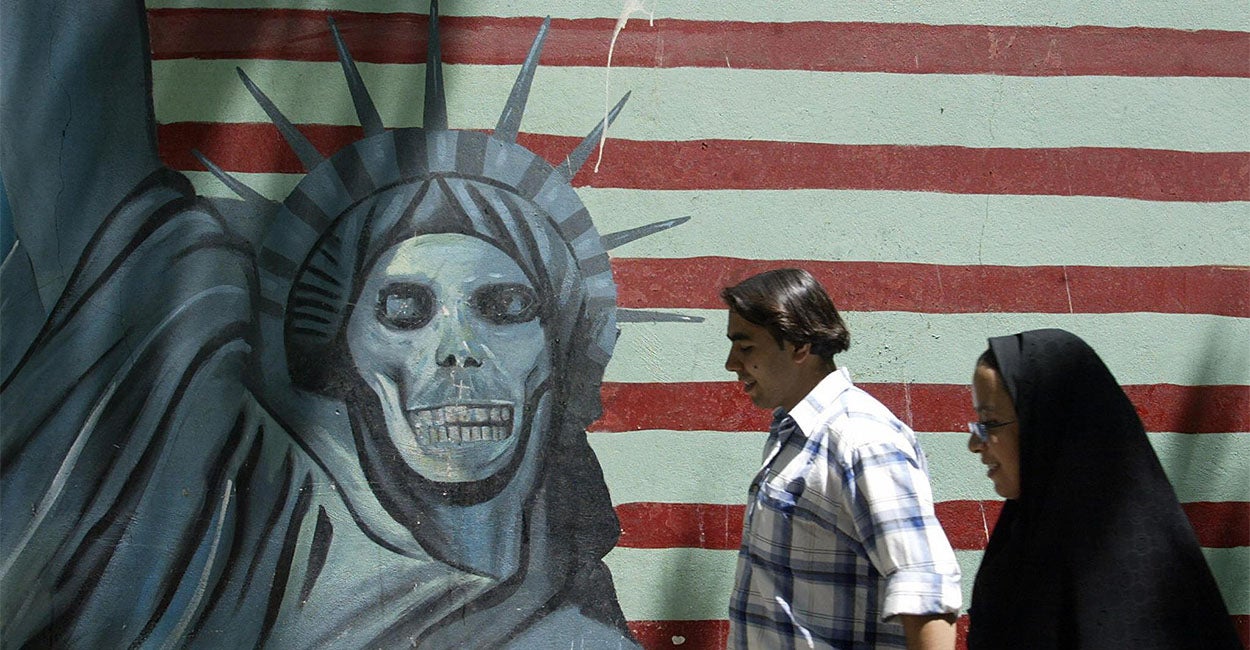
“Death to America” is not a slogan shouted by fringe protesters; it is regime policy, chanted at Friday prayers and emblazoned on missiles.
For decades, America managed this simmering war through sanctions, diplomacy, and targeted responses. We hoped the regime would evolve or that the Iranian people would eventually reclaim their nation. Containment worked—barely—because Iran lacked the ultimate weapon.
That changed as its nuclear program matured.
By 2025, Iran had amassed enough highly enriched uranium for multiple bombs, with breakout time measured in days or weeks. It had mastered advanced centrifuges, ballistic missile technology capable of delivering warheads, and the infrastructure to weaponize fissile material.
International inspections were stonewalled. Diplomacy had run its course. A nuclear Iran was not a theoretical threat; it was weeks away from crossing the threshold.
In June, the United States and Israel conducted Operation Midnight Hammer, striking key nuclear facilities at Natanz, Fordow, and Isfahan. It was hoped these precision strikes would cripple the program and demonstrate American resolve.
In early 2026, during the final rounds of Omani-mediated negotiations in Geneva, Iranian negotiators bragged to the American team—led by Special Envoy Steve Witkoff and including Jared Kushner—that Iran still controlled roughly 460 kilograms of uranium enriched to 60%. They openly stated they knew this stockpile was sufficient to produce material for approximately 11 nuclear bombs and insisted on their “inalienable right” to continue enriching uranium.
For reference, commercial nuclear power requires only 3–5% enrichment; anything above 20% is considered Highly Enriched Uranium and is weapons-usable.
That is why the United States and Israel launched the current military campaign.
Precision strikes have further degraded Iran’s nuclear sites, crippled missile/drone production and launch facilities, and devastated leadership and the IRGC military. The operation is not escalation. It is self-defense—the only responsible way to end a 47-year conflict before it could inflict catastrophic damage. America could no longer afford to “manage” the conflict. It was time to put it to bed.
Iranian officials have repeatedly vowed to use any means necessary to defeat “the infidels.” Their proxies attack Americans and our allies while the regime chants for our annihilation.
A nuclear weapon in their hands would not sit in a silo as a bargaining chip. It would be a divine instrument to strike the Great Satan.
History teaches that religious zealots who believe they are fulfilling prophecy do not behave like rational actors. We have seen it with suicide bombers and 9/11 hijackers. Scaling that fanaticism to nuclear capability is a risk no responsible American leader could accept. The military operations now underway are not about regime change for its own sake, though a post-theocratic Iran at peace with its neighbors and its own people would be a benefit to the region and the world.
Operation Epic Fury is about preventing the next 9/11 from becoming a nuclear horror. It is about protecting American lives, American allies, and the American way of life from an enemy that has been at war with us since 1979.
We publish a variety of perspectives. Nothing written here is to be construed as representing the views of The Daily Signal.