
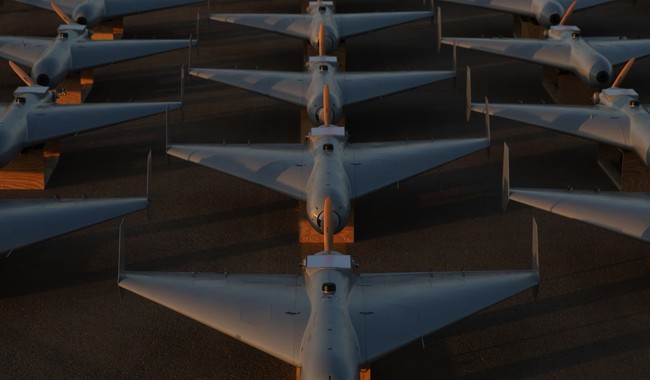
The United States conducted its first combat use of the Low-Cost Unmanned Combat Attack System (LUCAS) drones during Operation Epic Fury, targeting Iranian Islamic Revolutionary Guard Corps facilities, missile sites, and air defense installations.
The LUCAS drones were developed as a direct adaptation of the Iranian Shahed-136 design, which the regime is currently using to attack civilian targets in Gulf states like Bahrain and Dubai.
The U.S. made several improvements on Iran’s drone and used them to saturate Iranian air defenses. In addition to upgrading the flight and anti-radar capabilities of the drone, the Department of War, under the direction of the Trump administration, added explosive payloads comparable to a Hellfire missile but at significantly lower cost. The operation marked the first time the U.S. military employed long-range, one-way attack drones in combat.
The Trump administration deserves credit for accelerating the program through a series of rapid policy and procurement actions. In June of 2025, President Trump signed Executive Order 14307, “Unleashing American Drone Dominance,” which directed federal agencies to prioritize domestic drone manufacturing, remove regulatory barriers, and expedite the fielding of low-cost unmanned systems.
In July 2025, Secretary of War Pete Hegseth issued a follow-up memo that rescinded previous restrictions on drone procurement and mandated the rapid integration of affordable drones. Weapons acquisition reforms spearheaded by Hegseth enabled the speed of development of the LUCAS drones. These changes allowed the program to move from concept to deployment at a significantly faster timeline than other weapons programs.
The manufacturing of these drones would never have been possible without Arizona-based contractor SpektreWorks, which worked with Iranian Shahed-136 parts recovered from Ukraine. CENTCOM then established Task Force Scorpion Strike in December 2025 to oversee testing and fielding in the Middle East, and the shipboard launch was conducted the same month.
RELATED: Secretary of War Hegseth Sends the Remaining Mullahs a Pointed Warning – and a Few Promises
Compared with the original Shahed-136, the LUCAS offers several technical improvements. The U.S. version is lighter, carries a more explosive warhead, and achieves a range of about 500 miles with up to six hours of endurance. It also incorporates AI-driven autonomous navigation, inertial guidance, and satellite capability (including Starlink integration) for mid-flight retargeting and jam resistance. LUCAS also supports mesh networking for coordinated swarm operations, enabling multiple drones to share targeting data and adapt to defenses in real time.
Iranian officials were aware of the LUCAS program since its public unveiling in December 2025 and have publicly characterized it as an admission of the effectiveness of their own drone technology. Brig. Gen. Abolfazl Shekarchi, spokesman for Iran’s armed forces, described the U.S. adaptation as evidence that Washington was “kneel(ing) before an Iranian drone.” On Saturday, it was Iran’s interceptors that knelt to the enhanced effectiveness of their own design as the LUCAS drones proved to be overwhelming.
The deployment of LUCAS represents a shift toward America’s use of scalable, low-cost systems developed quickly. If this program’s rapid timeline and operational success are a reflection on the Administration’s ability to close capability gaps, then the best is yet to come, especially with hypersonic missile production now underway.
Editor’s Note: Thanks to President Trump and Secretary of War Pete Hegseth’s leadership, the warrior ethos is coming back to America’s military.
Help us report on Trump and Hegesth’s successes as they make our military great again. Join RedState VIP and use promo code FIGHT to get 60% off your membership.