A culture that neglects the beautiful is a culture that will quickly become disenfranchised with the true and the good.
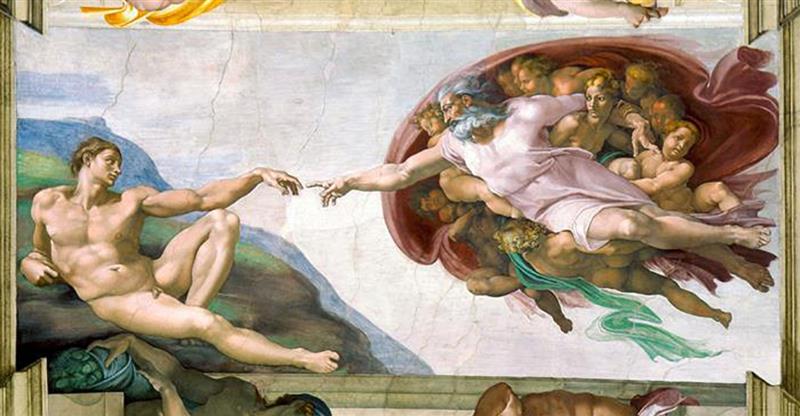
Michelangelo was born on March 6, 1475. He was a sculptor, painter, poet, and architect who radically impacted his time period and the generations to follow. He is best-known for his paintings in the Sistine Chapel of The Last Judgment and of the creation of man found on its ceiling, but his primary focus as an artist was his sculpture pieces.
The life, witness, and legacy of Michelangelo ought to evoke a greater appreciation for art, but, more importantly, it can offer a blueprint for how to be captivated by the true, the good, and the beautiful. Ultimately, our appreciation for truth, goodness, and beauty will only be safeguarded in a worldview that respects faith in God. The more we place value on these three characteristics of existence, the more human we will become.
“Every beauty which is seen here by persons of perception,” Michelangelo said, “resembles more than anything else that celestial source from which we all.” Truth, goodness, and beauty are sometimes referred to as “transcendentals” in philosophy because they apply to all things that exist.
To know something truly means that the one’s mind aligns with what the thing is. We know the truth when what we think about a subject or object is actually the case in reality. For something to be good means that it is achieving the purpose that it was made for (for example, a knife that cannot cut through butter is a bad knife). To be good is to achieve the reason for the thing’s existence.
Beauty, according to St. Thomas Aquinas, means that a thing has wholeness, harmony, and clarity. If something contradicts one of these qualities, then it is lacking in beauty. In order to appreciate beauty, one must take the time to be aware of what is in front of us (whether that is a piece of art or a landscape).
Michelangelo is also attributed with saying, “Every block of stone has a statue inside it and it is the task of the sculptor to discover it.” The art of the Renaissance—and all beautiful art of any age—is meant to bring us into contact with the divine. In order to perceive this, it takes diligence and effort. It takes an eye for appreciating the world around us.
In a practical way, it is challenging to appreciate the world around us if we are always looking down at our screens and always have our earbuds on. The average American spends about 7 hours a day on screens, while Gen Z spends an average of 9 hours daily. The witness of Michelangelo can teach us today to slow down and unplug. To take a closer look at the beauty that surrounds us in nature, in our loved ones, and in great art. Yes, because screen time destroys our brain, but also because our time is better spent elsewhere.
This means that we must be willing to reject being in a rush. “Genius,” Michelangelo said, “is eternal patience.” He was able to craft those masterpieces because he was gifted, but most importantly, because he was willing to take the time. How much could our society benefit from using a portion of our screen time in order to read the great books of western tradition, learn about great figures in history, or simply converse with their loved ones? All of these would open us up to becoming more susceptible to the grandeur of the world around us rather than consumed by the addictive devices in our pockets.
Finally, we can learn from Michelangelo by refusing to settle for a mediocre existence. Few of us will ever have the fame he did. Most of us will never create something that will survive centuries and be venerated by millions of people. However, we can learn from the witness of Michelangelo regarding our goals. The works he created often took years of tireless effort. He was patient and attentive to his work because that is what greatness demands of us. In a world that tempts us to choose the quick fix, he relentless effort to create beautiful and time consuming works reveals that we are made for goals that require a lot from us.
Is it possible that, as a culture, we are not setting high enough standards for our love of things that are everlasting like the true, the good, and the beautiful? Michelangelo might think so. In order to learn from the magnitude of his life and work, let’s consider how we can spend more time slowing down and focusing on what is right in front of us. It might just make us more aware of just how beautiful and good this world truly is.
We publish a variety of perspectives. Nothing written here is to be construed as representing the views of The Daily Signal.