Part 2
The Islamic Republic of Iran (IR) is not only a physical danger to the U.S. and its citizenry, but also a danger to our economic welfare. This is because the Middle East is both in a crucial location in the middle of the globe and a vast source of energy, both oil and natural gas. Many of the nations within the Middle East are energy producers, including Iran, and their vital product travels from the Middle East to Europe, the U.S., Asia, and other parts of the world.
ALSO SEE: Why We Fight Iran
There are two crucial choke points in the Middle East – the Strait of Hormuz and the Bab al Mandeb. The Strait of Hormuz is a sea route between Iran and Oman that functions as a vital artery for the global oil trade, with roughly 13 million barrels per day passing through it in 2025, which represents about 31 percent of all seaborne crude flows. The Bab al Mandeb Strait is the waterway between Yemen and Djibouti that can be used to cut off trade from the Red Sea to the Mediterranean by way of the Suez Canal. It attracts about 12 percent to 15 percent of worldwide trade and about 30 percent of global container traffic — with more than $1 trillion in goods transiting annually. This includes roughly 9 percent of global seaborne oil flows (about 9.2 million barrels per day in early 2023) and around 8 percent of liquefied natural gas (LNG) volumes. An average of fifty to sixty ships transits the canal daily, carrying an estimated $3 billion to $9 billion in cargo value.
Both of these choke points have been threatened by the IR in the past. In the 80’s, during the Iran-Iraq War, both Saddam Hussein’s Iraq and the IR threatened the energy trade:
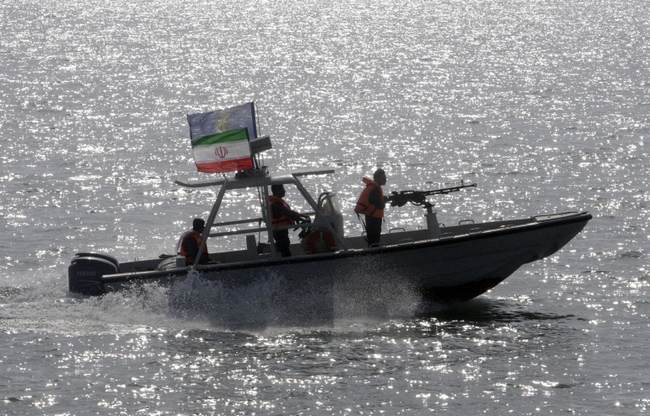
The fighting in the gulf became known as the Tanker War, as both sides attacked hundreds of oil tankers in an effort to disrupt the economy of the other side. Iraq, lacking a significant navy, attacked mostly from the air, while Iran used surface vessels and mines in the shipping lanes. Two Iranian frigates, the Sahand and Sabalan, were especially noted for brutal attacks on unarmed neutral shipping.
The U.S. began escorting international shipping through the Persian Gulf. On 14 April 1988, the U.S. frigate Samuel B. Roberts hit an Iranian mine and barely escaped sinking. On April 18, 1988, President Ronald Reagan authorized Operation Praying Mantis:
(T)he U.S. Navy destroyed two Iranian oil platforms, sunk one frigate and a missile boat, crippled a second frigate, destroyed at least three armed speedboats, and drove off Iranian F-4 Phantom jets with missile fire. In just a few hours, American forces obliterated nearly half of Iran’s operational fleet.
And the IR has been a repeat offender when it comes to threatening world and energy trade. Post-October 7, 2023, the IR used their proxy, the Houthis in Yemen, to terrorize international shipping in the Red Sea, resulting in almost 25 percent of global shipping capacity being diverted. This diversion added thousands of miles and a week or two to trips and thereby disrupted the supply chain and increased inflation.
The U.S. was, once again, forced to intervene. From March through May of 2025, the U.S. launched a large campaign of air and naval strikes against Houthi targets in Yemen, codenamed Operation Rough Rider.
In this most recent conflict, as RedState has reported, the IR is again shooting missiles at neighboring countries and attempting to disrupt the international trade going through the Strait of Hormuz:
Only three oil vessels from Persian Gulf monarchies crossed the strategic waterway Sunday, according to Kpler. That led to a collapse of exports from 22 million barrels a day to 2.8 million barrels a day, the commodities-data company said. About 706 non-Iranian tankers are now anchored outside the Strait unable to cross, it said.
And as a result, President Trump has announced:
If necessary, the United States Navy will begin escorting tankers through the Strait of Hormuz, as soon as possible. No matter what, the United States will ensure the FREE FLOW of ENERGY to the WORLD. The United States’ ECONOMIC and MILITARY MIGHT is the GREATEST ON EARTH — More actions to come.
READ MORE: Maritime Lifeline: Trump Offers Straits of Hormuz Naval Escorts, Political Risk Insurance
The Energy Squeeze China’s in Over Operation Epic Fury Is Just a Foretaste of What Is Yet to Come
Granted, this time, the IR is disrupting international trade because the U.S. and Israel initiated a kinetic attack on the IR. But the IR is also behaving as it always does, when it is in danger – widely striking out against other nations, many not involved in the hostilities, and endangering international trade. And there is nothing unusual or unprecedented about the U.S., or any nation, resorting to kinetic actions in response to foreign actions that could harm its economy.
In fact, there is a term for these kinds of kinetic actions, as described by noted foreign policy expert Walter Russell Mead – “gunboat” diplomacy.
Therefore, the U.S. decision to attack the IR, targeting its troops and leaders for destruction, could deter, punish, and even destroy an enemy regime with a proven track record of endangering world trade, especially the energy trade, and thus serves our national interest in protecting the homeland and the American people.
To be continued…