
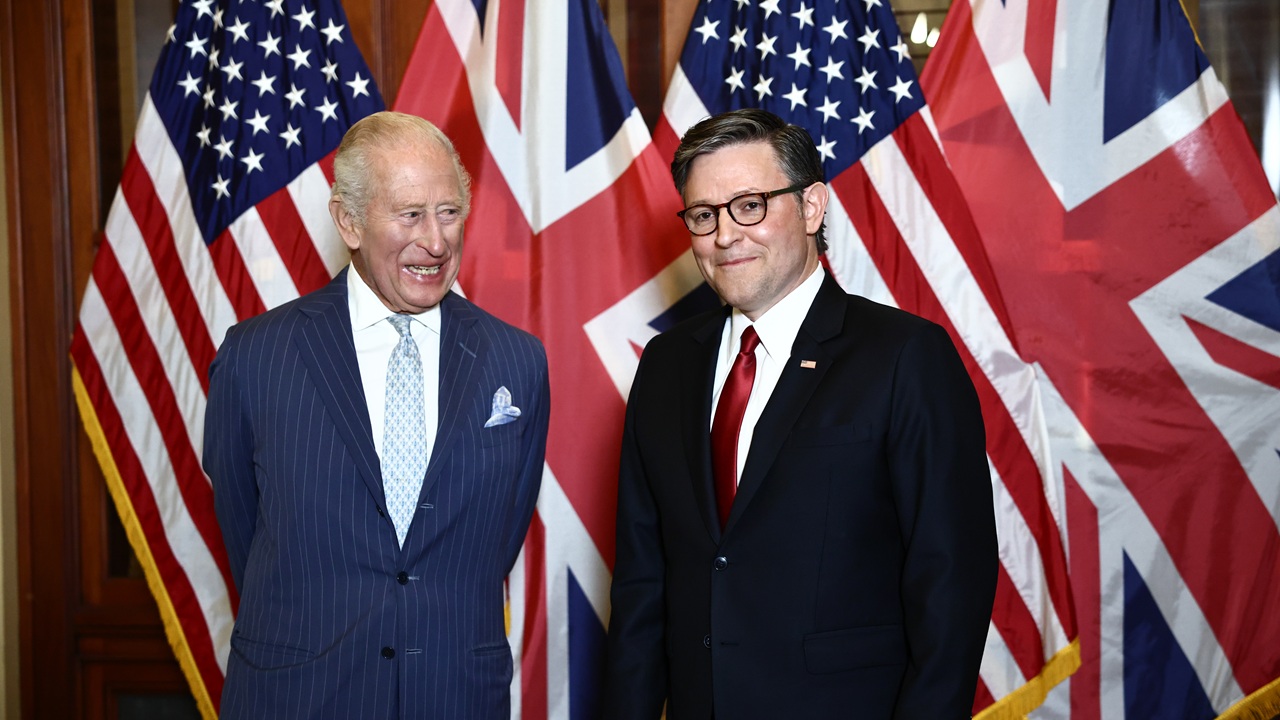
It may seem odd that the reigning English monarch is visiting the United States to celebrate the 250th anniversary of American independence. Yet as King Charles III acknowledged in his speech to a joint session of Congress, the ties binding the American Republic and the United Kingdom are stronger than any ill will lingering from the late unpleasantness of the Revolution.
Perhaps the most remarkable thing about His Majesty’s speech is how he noted the ways that the constitutional vision of the American Founders is an inheritance of Western civilization through our British ancestors.
“They carried with them, and carried forward, the great inheritance of the British Enlightenment—as well as the ideals which had an even deeper history in English common law and Magna Carta,” he said. “These roots run deep, and they are still vital.”
While Charles acknowledged the real problems facing the English-speaking peoples, he averred that returning to those deep roots will sustain us.
The wisdom at the heart of the King’s speech reflects the insights of a great American conservative thinker: Russell Kirk. In his 1974 “Roots of American Order”—written to commemorate the 200th anniversary of American independence—the Michigan writer also stressed the need to understand the common roots of British and American civilization.
Like His Majesty, Dr. Kirk did not conceive of this legacy as some kind of narrow ethnic heritage, let alone a blood-and-soil nationalism. Rather, both men understand the West as a kind of spiritual inheritance.
Kirk opened “The Roots of American Order” by defining his terms. “We can distinguish two sorts of roots, intertwined,” he wrote, “the roots of the moral order, of order in the soul; and the roots of the civil social order, of order in the republic.”
Building on the work of political philosophers such as Simone Weil and Eric Voegelin, Kirk argued that institutions, customs, ideas, and culture all shaped who Americans are as a people. If we were to “freshen the colors of the picture” we have of American civilization, he went on to write, then we must look to the sources of those inheritances—specifically, in the four great cities of the West: Jerusalem, Athens, Rome, and London.
From Jerusalem, Americans inherited a certain conception of the human person and his place in a divinely created order. The Hebrew Prophets were lawgivers who established certain moral principles that still help us discern right from wrong. And, of course, as Charles would say in the House of Representatives years after Kirk, “the Christian faith is a firm anchor and daily inspiration that guides us not only personally, but together as members of our community.” Without these religious roots, the Anglo-American conception of freedom would be altogether unintelligible. Only faith can truly sanction liberty.
From Athens and Rome, Kirk argued Americans received a great philosophic heritage. The writings of Plato, Cicero, and other Greek and Roman sages represent the origin of liberal education.
But, curiously, the Framers of the U.S. Constitution did not look to what Publius called in Federalist no. 9 the “petty republics of Greece and Italy” as models for the political forms of their new country. Instead, Kirk maintained, the Founders primarily took inspiration from British history.
London may have been “the youngest of the four cities from which American order is drawn,” Kirk wrote, but it is the most influential. “America’s classical heritage, and in some sense even America’s Christian and Jewish heritage, crossed the Atlantic only after being transmuted by Britain’s historical experience,” he contended.
From the Middle Ages to the Glorious Revolution, a conception of justice as the rule of law—not of men—emerged in the city on the Thames, working itself out as a series of limits on power and, ultimately, a mixed constitution. When English settlers came to North America seeking freedom and fortune, they replicated those free institutions on these shores. As Kirk put it:
Of medieval London, few traces remain today: most of its fabric vanished in the Great Fire of the seventeenth century, and remnants were demolished after the First World War or effaced by German bombs in the Second World War. Even St. Paul’s is a neoclassical building on the medieval site of Ludgate Hill; even the famous river profile of the Parliament Houses is nineteenth-century Gothic. But the invisible London, the city of the rule of law, the city of enterprise and cultural diffusion, still overshadows New York and Washington.
It is for this reason that Kirk could declare that the War for Independence was “a revolution not made, but prevented.” The American Founders were not attempting, as their would-be imitators in France tried later, to rip up the contract of eternal society and introduce modes and orders altogether new. Theirs was a revolution of memory, an attempt to defend ancient and natural liberties against the schemes of centralizing power.
In that sense, Kirk argued, the Founders were doing their best to uphold the inheritance of London in an uncertain time. Or, as His Majesty charmingly put it, “The Founding Fathers were bold and imaginative rebels with a cause … By balancing contending forces and drawing strength in diversity, they united 13 disparate colonies to forge a nation on the revolutionary idea of ‘life, liberty and the pursuit of happiness.’”
Today, the English-speaking peoples on both sides of the Atlantic need a dose of that boldness and imagination to withstand the multiple crises we face. The United States and United Kingdom alike face the threats of foreign aggression and domestic decadence. As both Kirk and the King remind us, it is only by drawing on the common spiritual heritage of our two peoples—remembering our roots—that we might restore order in the commonwealth, and order in the soul.
We publish a variety of perspectives. Nothing written here is to be construed as representing the views of The Daily Signal.