
Most people live for the weekend. Whether a student waiting for that last Friday bell to ring or a businessman finishing up his last meeting of the week, human beings desire to be freed from work. The most extreme form of this might be the way that many people long for retirement, a time when, supposedly, all work will be behind a person.
From the Christian perspective, though, work is good for the human person. Jesus Christ Himself learned how to work at the knees of his earthly father, St. Joseph, and on May 1, the Catholic Church reminds all Christians of this reality.
May 1 is the feast day of St. Joseph the Worker in the Catholic Church. Pope Pius XII instituted the feast of St. Joseph the Worker in 1955, in part as a response to communist celebrations of “International Workers’ Day.”
In the Scriptures, we learn that Joseph was a carpenter when Jesus returns to his hometown of Nazareth and the people reject him. They ask: “Is he not the carpenter’s son?” (Matthew 13:55). The Greek word translated as carpenter is tekton, which means “craftsman, artisan, or builder.”
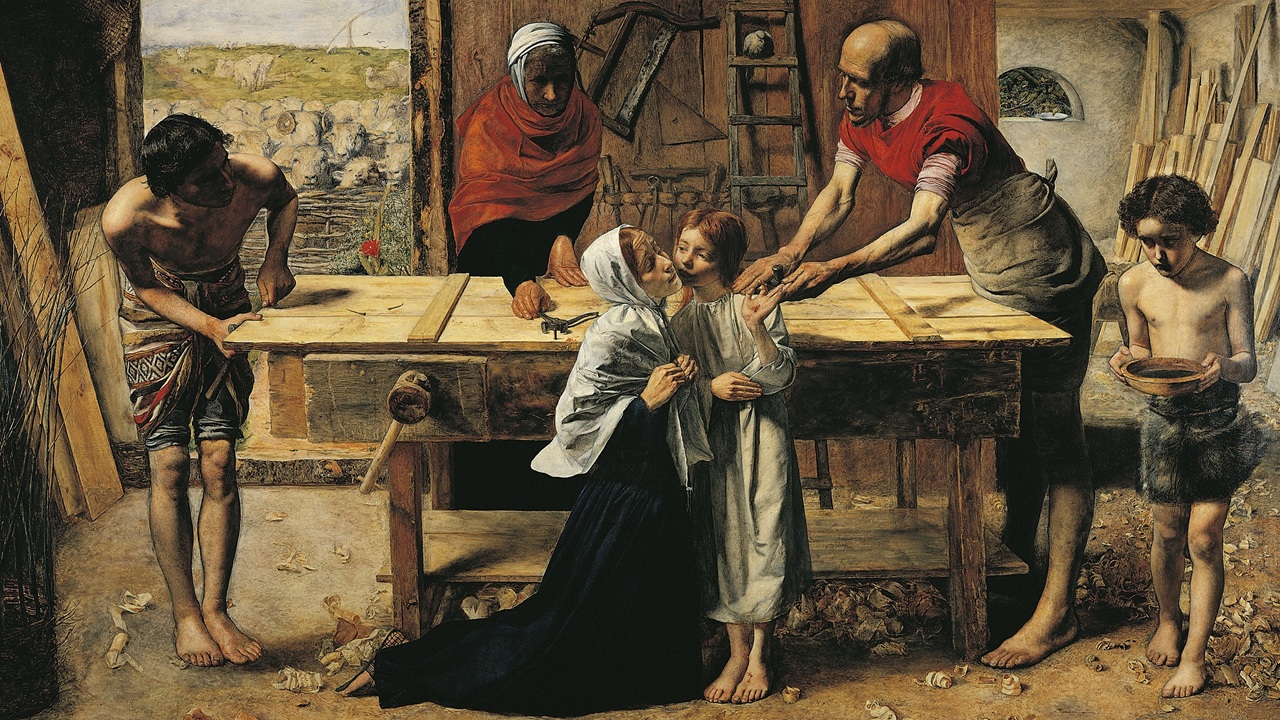
Joseph was a hard worker. He knew what it was like to be entrenched in manual labor each day. Jesus would have grown up with Joseph at the workshop, learning from his foster father.
The fact that the Church designates a day to honor St. Joseph and the importance of work highlights the need for humanity to reflect on how work can sanctify us.
Work first appears in the Bible during the creation stories in Genesis. We are told that God “took the man and settled him in the garden of Eden, to cultivate and care for it” (Genesis 2:15). Human beings were made to be in contact with and work with creation. In this way we find fulfillment as the pinnacle of creation.
Then the animals were created and God “brought them to the man to see what he would call them; whatever the man called each living creature was then its name” (Genesis 2:19). This task shows man’s dominion over creation, but it also demonstrates that work is itself a participation in God’s creation.
Work was not given to be a burden but a gift. Work allows us to create and become like God, who is the Creator.
After the fall in the Garden of Eden, man’s work became arduous. However, that did not change the underlying fact that work is itself good—no more than pains in childbirth make children anything other than a gift. In fact, work’s unpleasantness and the pain of childbirth are part of the remedy of sin. They help the human person to learn sacrificial love. Work is redemptive; it teaches us to be selfless, rather than selfish.
In 1961, Pope John XXIII explained that work is a specifically human activity which is both necessary and personal. In his encyclical “Mater et Magistra” (On Christianity and Social Progress), he taught that man needs to work in order to provide for the necessities of life, such as food, water, shelter, and clothing.
Joseph was a witness to this. He worked long hours to provide for Mary and Jesus. Jesus saw the strength and commitment of his earthly father, who was willing to endure his labor out of love for his family.
All men and women today who work to provide for their families do the same. Our work, when approached properly, is an avenue for us to sacrifice and show our love for our families. In the contemporary world, such work usually also requires us to sacrifice time away from our families in order to provide for them. Our work takes us away from them, but in that separation we can learn to love them more.
Work is also personal. It is only possible because of the distinctive human faculties of intellect and will.
Work binds people together. Many form their strongest relationships at the workplace. This is due to the fact that work is interpersonal. The many images of Jesus and Joseph together in the workshop testify to this reality.
When Jesus was crucified with hammers, nails, and wood, he must have recalled all the hours spent with Joseph as a boy in Nazareth in the workshop. The time they spent together bound them together in love.
We, too, can be strengthened by our colleagues to persevere through tough times. We can lift each other up when there are challenges in the workplace because we know that we do not go through anything alone.
In these ways, we can see that work is good for us. The challenge is to not let work define us. Many people live to work instead of working so that they may live. Work can consume us. It can drain us physically, emotionally, and intellectually.
Despite the temptation to make work our god, and despite the many challenges that come with working in the 21st century, let us learn from the witness of St. Joseph that work is necessary and personal. Work teaches us to love sacrificially, and it binds us together as a part of the human family.
We publish a variety of perspectives. Nothing written here is to be construed as representing the views of The Daily Signal.