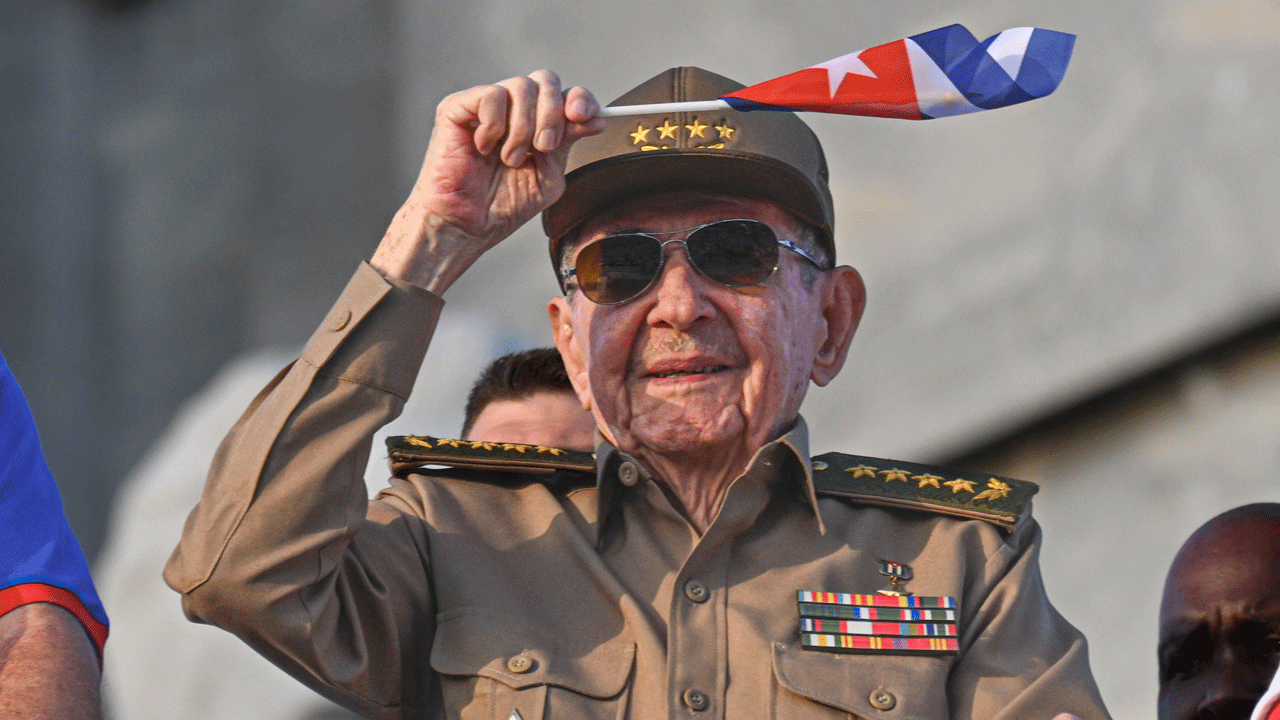
After the Department of Justice unveiled charges against Raul Castro, the former socialist leader of Cuba, Congress is divided between those eager to see the regime forcefully toppled and those who think America has its hands full with Iran.
On Tuesday, it was revealed that a Florida grand jury has indicted Castro and five others in connection with the fatal downing of two American planes in 1996 that resulted in the deaths of three Americans delivering aid to Cuba. The charges come amid a U.S. blockade of shipments to the island.
Castro, whose brother Fidel led the nation from 1959 to 2008, has been charged with murder.
Although Raul Castro, 94, left the government in 2021, he and his family members continue to be influential in Cuba.
Acting Attorney General Todd Blanche said of the steps to make Castro face justice, “This isn’t a show indictment. … There was a warrant issued for his arrest, so we expect that he will show up here by his own will or by another way.”
For Florida Republicans who represent anti-Castro Cuban-Americans, the charges and their implications for the regime’s survival are cause for celebration.
“Today is a glorious day. After six decades of tragedy, of misery, of distress, Cubans will be free soon,” Rep. Maria Elvira Salazar, R-Fla., said Tuesday morning. “There are no words to describe the joy they feel—not only the Cubans on the island, but the Cubans that we represent in South Florida.”
Salazar, who represents a Miami district, was joined by fellow Florida Republican Reps. Carlos Gimenez and Mario Diaz-Balart.
Comparing Castro to the toppled leaders of Venezuela and Iran, Salazar spoke of a new future for the island.
“A friendly Cuba, a prosperous Cuba, will help with the United States economy, with politics, with immigration. And that is what this country needs—friends in this Western Hemisphere,” she said. “Today marks the moment when 60 years of destruction will come to an end.”
The prosecution of Castro is reminiscent of the prosecution of former Venezuelan President Nicolas Maduro on drug trafficking charges, which the administration used as justification for the capture of the head of state.
Sen. Rick Scott, R-Fla., told the Daily Signal he’d like to see regime change in Cuba, but that this would not necessarily have to involve military action, as scarcity induced by a blockade could trigger an uprising. He did not, however, rule out force.
“Castro controls all the money. … Now the money’s drying up because of what [President Donald] Trump has done,” he said. “But if you look at the people of Cuba, they’re willing to fight for their freedom. … Hopefully now they’re seeing that America will stand up for them, they’ll do it on their own.”
But Scott added, “We should not take anything off the table. I mean, the same thing that happened to Maduro should happen to Raul Castro. But I’m not going to get ahead of whatever the Trump administration wants to do.”
Moreover, Florida Republicans view ending the Cuban dictatorship as a good start at bringing freedom to the Western Hemisphere. Both Salazar and Gimenez mentioned Nicaragua as another nation in need of liberation from dictatorship.
But some in Congress outside of the South Florida Cuban milieu are not so eager to aggravate another regime as the United States continues to navigate a difficult economic and strategic situation after conflict with Iran.
“We can’t have another war there,” Rep. Ro Khanna, D-Calif., told the Daily Signal of Cuba. Khanna has spearheaded multiple efforts to restrain Trump’s war powers.
“You’ve had a war in Venezuela, a war in Iran. Let’s focus on jobs here.” He added that he supports efforts from “a number of leaders” in Congress ready to counter a potential military operation against Cuba.
Rep. Don Bacon, R-Neb., a member of the House Armed Services Committee, urged the administration to cool its jets on the Cuba issue.
“We got our hands in enough areas that we ought to be very cautious about overextending ourselves,” he told the Daily Signal.
“I’m a little weary about anything we’re doing in Cuba right now, even though Cuba’s a bad country. But after Venezuela [and] Iran, I just think let’s have a little bit of self-control,” said Bacon, who confessed he had not studied up on the latest Cuba developments and would have to “chew on it.”
Rep. Tim Burchett, R-Tenn., who sits on the House Foreign Affairs Committee, expressed his support for an economic approach to inducing regime change in Cuba, rather than a military one.
“Fidel was a murderer and they tried to make him some folk hero, and his little brother ain’t no better,” Burchett told the Daily Signal. “One thing we can do is economics and quit worrying about bringing in our military. … But that doesn’t seem to have worked for the last few years—for them anyway. I think it’s an option. I think we put international pressure on them.”
Democrats in the Senate could set up a political battle over a potential use of force against Cuba, as Sens. Tim Kaine of Virginia, Ruben Gallego of Illinois, and Adam Schiff of California have introduced a war powers resolution to prevent military action.
Scott reacted with rancor when asked about the resolution.
“I’m disgusted by what the Democrats have done,” he said. “I don’t get the Democrats. Don’t they want to live in freedom and democracy? Don’t they want people in Cuba and Iran … to have the same opportunities you and I have?”
The White House told The Daily Signal to direct a request for comment to the Department of Justice, which did not immediately respond.